

Why Counselling Is the Missing Piece in Addiction Recovery: How It Differs from Rehab and Why Both Must Work Together
Every year, thousands of families across India send a loved one to a rehabilitation centre hoping it will be the end of the addiction. And every year, thousands of those families watch the person return home, stay sober for a few weeks or months, and then relapse. Not because the rehab failed. Not because the person is weak. But because rehabilitation and counselling are two distinct things, and only one of them was provided. Understanding the difference between these two, and why the role of counselling in addiction recovery is irreplaceable, can fundamentally change how families approach de-addiction in India.
Rehabilitation removes the substance from the body. Counselling removes the reasons the person needed it in the first place. One without the other leaves half the job undone.
The addiction treatment segment in India is projected to reach USD 518 million in 2026, growing at over 8 percent annually. Yet despite this growth, research on de-addiction in India consistently documents that the majority of treatment facilities focus almost entirely on the medical and residential components of recovery, with counselling either absent or severely under-resourced. This gap is not just a service quality issue. It is the single biggest driver of relapse in India's de-addiction system.
The Role of Counselling in an Individual's Life: Beyond Addiction
Before understanding what counselling does in the context of addiction recovery specifically, it is worth understanding what counselling does in any individual life, because addiction is rarely just about the substance. It is almost always about something the substance was solving.
Counselling is a structured, professional relationship in which a trained therapist helps a person explore their thoughts, feelings, patterns, and experiences in a way that builds insight, develops coping skills, and creates the capacity for genuine change. Unlike talking to a friend, which can offer comfort and connection, counselling is directional. It moves toward something: greater self-understanding, healthier emotional regulation, more effective ways of managing the world.
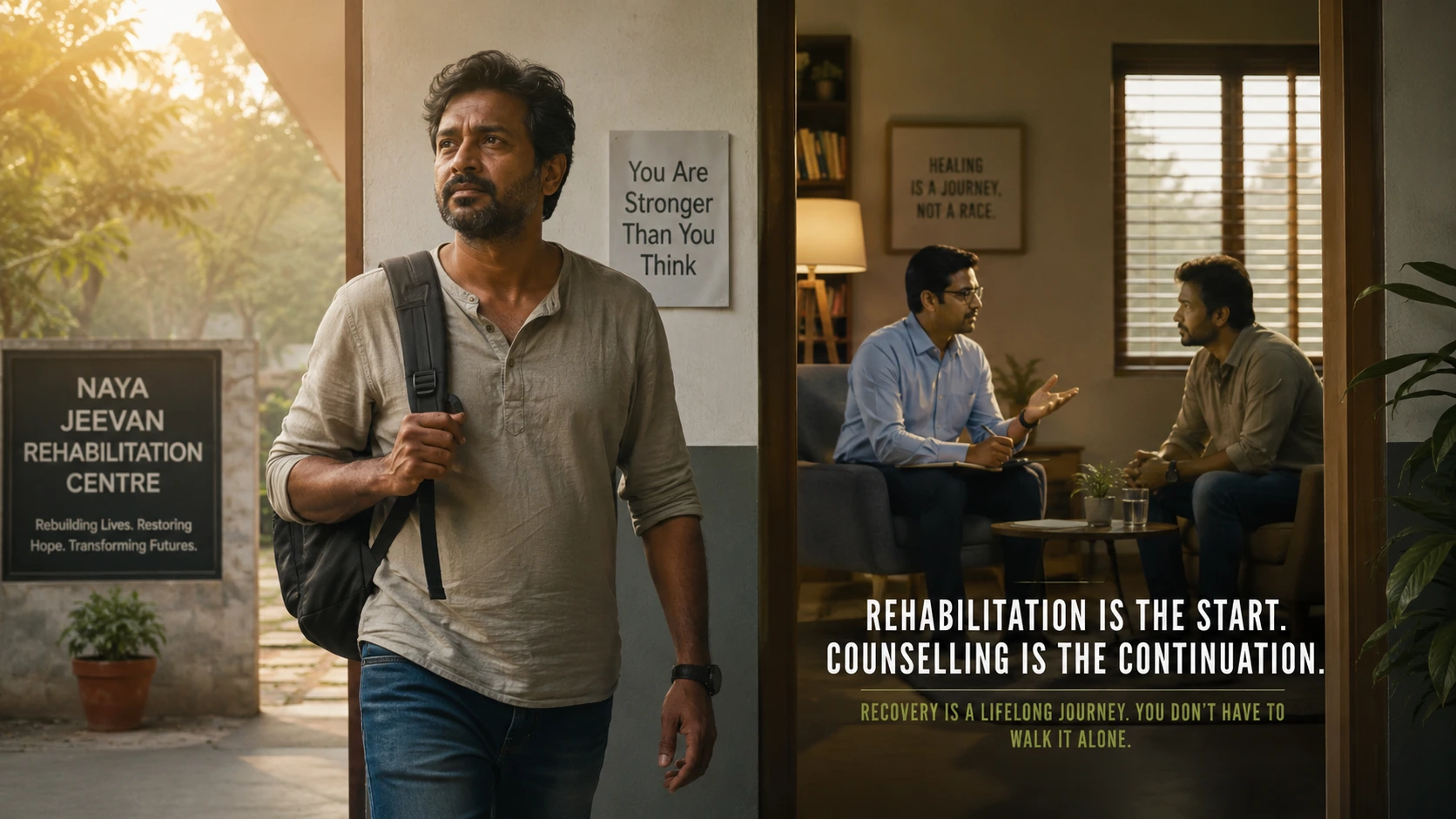
Counselling does not just address the problem in front of you. It builds the capacity to handle what comes after.
In an individual life, the role of counselling includes helping a person understand why they respond to stress the way they do, why certain relationships trigger specific emotional reactions, what beliefs about themselves they carry that limit their choices, and how their past experiences continue to shape their present behavior. These are not abstract psychological questions. They are the exact questions that, left unanswered, make it impossible to sustain any significant life change, including recovery from addiction.
Research published in the Journal of Consulting and Clinical Psychology found that people who receive counselling as part of addiction treatment have significantly better outcomes not only in terms of sobriety, but in overall life functioning: employment, relationships, mental health, and self-reported quality of life. The reason is that counselling addresses the whole person, not just the substance use.
"He came back from the de-addiction centre after 45 days. He was clean, he looked better, he was calm. We thought it was over. Within three months, he had relapsed. When I finally asked him why, he said: Nothing inside had changed. I just didn't have the drug. The reasons I started were still exactly the same." (Family member of a person in recovery, Himachal Pradesh)
What Rehabilitation Is, What It Is Not, and Why Families Often Confuse the Two
The word "rehabilitation" comes from the Latin rehabilitare, meaning to restore to a previous state. In the context of addiction, a rehabilitation centre provides a structured, safe, residential environment where a person can undergo medical detoxification, stabilise physically, and begin the process of separating from the substance and the environment that surrounds their use.
What Rehabilitation Genuinely Does
Medical detoxification under supervision is one of the most important things rehabilitation offers, particularly for substances like opioids, alcohol, and benzodiazepines where withdrawal can be physically dangerous or fatal without medical management. Rehabilitation also removes the person from the environment, the people, and the triggers that maintain their substance use. For many people, particularly those in severe addiction, this physical separation is the essential first step that makes any other work possible.
Good rehabilitation facilities also provide structure: regular meals, sleep schedules, physical activity, and a peer community of others in recovery. These elements, often completely absent from the life of someone in active addiction, have genuine therapeutic value. Group activities, peer support, and the simple experience of living alongside others who understand the struggle can be powerful.
What Rehabilitation Does Not Do
Rehabilitation does not change the psychological patterns, emotional regulation deficits, trauma histories, cognitive distortions, and relationship dynamics that drove the addiction in the first place. It does not resolve the grief, the loneliness, the shame, the undiagnosed anxiety or depression, or the family dysfunction that the substance was managing. It does not build the coping skills that will be needed when the person returns to ordinary life and ordinary stress. A rehabilitation centre that lacks robust counselling services is, at its best, a very expensive safe pause. The world the person returns to is unchanged. The internal world of the person is largely unchanged. The relapse risk remains very high.
Why Rehab Without Counselling Is a Revolving Door: The Evidence
The statistics around relapse after rehabilitation without counselling are sobering and consistent. Research across multiple countries and cultures shows that relapse rates for addiction without ongoing psychological support hover between 40 and 60 percent within the first year. For opioid dependency specifically, including the chitta dependency that is endemic across Punjab and parts of Himachal Pradesh, those rates can be significantly higher.
Detoxification treats the body's physical adaptation to a substance. It does not treat the addiction. Addiction is a disorder of thought, emotion, and behavior. It lives in the mind. That is where it must also be treated.
On the limits of medical detoxification alone in addiction treatmentThe mechanism of relapse after rehab without counselling follows a remarkably consistent pattern. The person returns home. Life resumes. Within days or weeks, the same stressors that preceded the addiction are present again: the same relationship tensions, the same financial pressures, the same loneliness or boredom or depression, the same friends in the same settings. The person has no substance in their body but no new tools in their mind. The craving, which is neurologically persistent long after detox, finds the same environment it left. The relapse is not weakness. It is predictable.
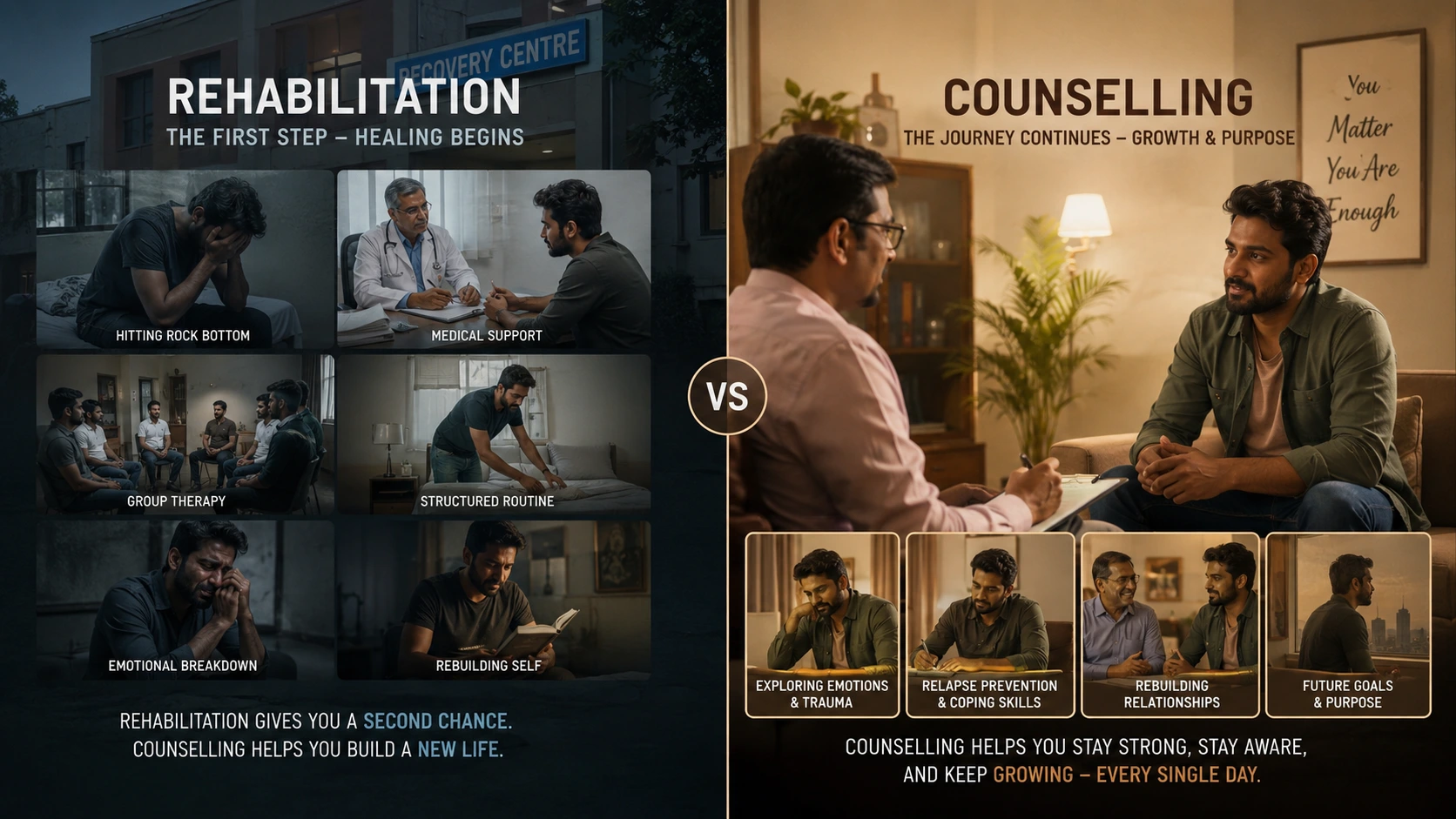
The revolving door of rehab without counselling: the environment changes temporarily. The internal world does not. The return to the same triggers with no new tools is how most relapses happen.
A 2024 report from the Recovery Research Institute found that of the many pathways to sustained recovery, those involving ongoing professional support, specifically therapy and counselling, produced the most durable outcomes across all demographic groups. The critical word is "ongoing": it is not just the counselling during rehab that matters. It is the counselling after rehab, through the first months and year of return to ordinary life, that determines whether recovery holds.
The Role of Counselling in De-Addiction vs Rehabilitation: A Detailed Comparison
| Factor | Counselling in De-Addiction | Rehabilitation (Rehab Centre) |
|---|---|---|
| Primary Focus | The psychological, emotional, and behavioral roots of addiction. Why the person uses, what it solves for them, and how to live differently. | Medical stabilisation, physical detoxification, and removal from the addiction environment. Getting the substance safely out of the body. |
| Where It Happens | Outpatient or online sessions in the person's own life. Also within residential settings when properly integrated. | Residential, typically 30 to 90 days in a structured centre away from the person's regular environment. |
| Who Delivers It | Trained addiction counsellors, psychologists, CBT therapists, family therapists. Requires specific professional training in addiction and therapy. | Medical doctors, nurses, psychiatrists for detox. Peer counsellors and group facilitators. May or may not include qualified therapists. |
| Duration | Long-term, ongoing. Typically months to years, with sessions becoming less frequent as stability builds. | Time-limited residential stay. Most programmes are 4 to 12 weeks. |
| What It Addresses | Trauma, shame, cognitive distortions, emotional dysregulation, co-occurring mental health conditions, relationship patterns, relapse triggers. | Physical withdrawal, medical complications, immediate crisis stabilisation, peer community building, structured daily routine. |
| Addresses Root Cause? | Yes, directly and specifically. | Partially, if counselling is integrated. Not if it is purely medical. |
| Relapse Prevention | Core explicit focus. Building skills, identifying triggers, creating response plans. | May include relapse prevention modules, but without ongoing counselling, the skills rarely hold under real-world pressure. |
| Family Involvement | Central. Family counselling is a core component of effective addiction counselling. | Variable. Some rehabs include family weekends or family therapy components, many do not. |
| Can It Work Alone? | For mild to moderate cases, yes. For severe dependency, counselling works alongside medical management. | Rarely sustains recovery long-term without ongoing counselling after discharge. |
| Cost in India | Rs 500 to Rs 3,000 per session. Online counselling expands access significantly. | Rs 20,000 to Rs 2,00,000+ for a full residential programme, depending on facility. |
How Counselling and Rehabilitation Complement Each Other in Addiction Recovery
The most effective approach to addiction recovery is not either rehabilitation or counselling. It is both, integrated, sequenced correctly, and maintained over time. When this integration happens, the outcomes are substantially better than either intervention alone. Here is how the two work together across the arc of recovery.
Most people entering rehab carry significant ambivalence. Part of them wants to recover. Part of them is terrified of losing the substance. Pre-rehab counselling, using motivational interviewing techniques, strengthens the person's own reasons for change and reduces dropout. People who receive even one or two counselling sessions before entering residential treatment show significantly higher engagement and completion rates.
The best rehabilitation centres in India embed counselling directly into their programmes. Group therapy, individual CBT sessions, trauma-informed approaches, and psychoeducation happen alongside the medical detox. This is when the person is most available for internal work: removed from triggers, stabilising physically, and in a structured environment. Rehab without this component is a missed opportunity.
The first three to six months after discharge from residential treatment is the period of highest relapse risk. This is precisely when real-world triggers, family tensions, cravings, and old social environments are re-encountered. Ongoing outpatient counselling in this window is not optional support. It is the mechanism by which everything learned in rehab is tested, consolidated, and embedded into a sustainable life. Without it, the rehab investment is frequently lost.
Research consistently shows that the probability of sustained recovery increases dramatically with time: after five years of continuous recovery, relapse risk drops below 15 percent. Getting to five years requires sustained support. Periodic counselling check-ins, even at lower frequency, and family counselling that addresses the relationship repair that addiction damages, form the long-term scaffolding of durable recovery.
A quality rehabilitation centre is not defined by its building or its cost. It is defined by whether it integrates counselling properly. When evaluating a de-addiction centre in India, the most important questions are not about the facilities. They are: Do you have qualified addiction counsellors on staff? How many individual therapy sessions does a person receive per week? Is there a family counselling component? What aftercare plan is provided at discharge? A centre that cannot answer these questions clearly is providing medical management, not comprehensive treatment.
The Role of Counselling in Addiction Recovery in India: Why the Gap Is So Wide
India's addiction treatment system faces a unique challenge that a 2025 paper in the Indian Journal of Psychiatry described directly: the role of the "counsellor" in Indian de-addiction settings is arguably the most misconstrued in the system. Requirements for becoming a counsellor are ambiguous, and in many facilities, the title is given to individuals with limited or no formal training in either addiction medicine or psychological therapy. This means the counselling component, when it exists at all, may not be delivering the evidence-based intervention that the research supports.
The result is that many families in India have experienced the rehab-relapse cycle multiple times without understanding why. The person did everything right: they agreed to go, they completed the programme, they returned clean. And then life happened, and the tools were not there.
States like Himachal Pradesh, Punjab, Haryana, and Rajasthan, which bear a disproportionate burden of opioid and alcohol dependency, have fewer qualified addiction counsellors per capita than urban metros. Online counselling has begun to close this gap, allowing people in Mandi, Solan, Kangra, and remote areas to access qualified addiction counsellors without having to travel to Shimla or Delhi. This is not a compromise. For most presenting concerns in addiction recovery, online counselling with a qualified therapist produces outcomes equivalent to in-person sessions.
Types of Counselling Used in De-Addiction and Addiction Recovery
Not all counselling in addiction recovery looks the same. Different approaches address different dimensions of the problem, and in comprehensive treatment, several are used together.
-
Cognitive Behavioural Therapy (CBT)The most extensively researched counselling approach for addiction. CBT helps people identify the thought patterns that drive substance use, challenge distorted beliefs, and develop concrete behavioral strategies for managing cravings and high-risk situations. Studies consistently show CBT reduces relapse risk by 40 percent or more when combined with other treatment.
-
Motivational Interviewing (MI)A counselling technique specifically developed for people who are ambivalent about change. MI works with the person's own reasons and values to strengthen their motivation for recovery. It is non-confrontational, which makes it particularly effective in cultures where direct challenge of behavior produces shame and withdrawal rather than change.
-
Trauma-Informed CounsellingA significant proportion of people with substance use disorder carry unprocessed trauma, including childhood abuse, neglect, loss, violence, and relational trauma. Trauma-informed approaches address this directly, recognising that substance use is frequently a response to pain that has never been safely processed. Without addressing the trauma, the substance craving persists as a coping mechanism.
-
Relapse Prevention CounsellingA structured component that identifies personal triggers, high-risk situations, early warning signs of relapse, and specific response plans for each. This is not abstract. It is detailed, practical, and personalised. It asks: when you feel this, in this context, with this person, what exactly will you do? The specificity is what makes it effective.
-
Dialectical Behaviour Therapy (DBT)Particularly useful for people with co-occurring emotional dysregulation, self-harm, or borderline features alongside addiction. DBT builds emotional regulation skills, distress tolerance, mindfulness, and interpersonal effectiveness, the four areas most commonly deficient in people with severe addiction.
-
Group CounsellingFacilitated by a trained therapist, group counselling creates a structured space where people in recovery share experiences, challenge each other's denial and rationalisations, and provide mutual support under professional guidance. It is distinct from peer support groups like AA, which are also valuable but are not therapist-facilitated.

Sustainable recovery is built internally, through the psychological work that counselling makes possible. The physical work of detox creates the space. The psychological work of counselling creates the future.
Why Family Counselling Is Not Optional in Addiction Recovery
Addiction does not happen in isolation. It happens inside a family system, and that system is deeply shaped by the addiction. Enabling behaviors, co-dependency, the exhaustion and secondary trauma of family members, the damaged trust, the children affected by a parent's addiction, the spouse who has spent years managing around the drinking or the drug use: all of these are realities that do not resolve automatically when the person in recovery comes home.
Family counselling in addiction recovery serves several distinct purposes. It educates family members about addiction as a condition, not a moral failure, which reduces shame and blame and creates a more genuinely supportive environment. It identifies enabling behaviors that family members may not recognise in themselves and that, if unchallenged, actively undermine recovery. It addresses the secondary trauma and mental health impact on partners, children, and parents, who often carry significant anxiety and grief of their own. And it rebuilds the communication patterns that addiction systematically destroys.
Research from Bortolon et al. published in Ciência and Saúde Coletiva found that family functioning was one of the strongest predictors of sustained recovery outcomes. People whose families received counselling alongside their own treatment showed significantly better long-term sobriety and quality of life than those whose families were not involved. The family is not the audience for recovery. It is a participant in it.
When to Choose Counselling, When to Choose Rehab, and When to Choose Both
The decision is not either/or. But the right combination and sequence depends on the severity of the dependency, the physical safety of withdrawal, and the individual circumstances of the person.
For mild to moderate substance use, where physical withdrawal is not medically dangerous, where the person has some stable support in their environment, and where they are motivated to engage with the therapeutic process, outpatient counselling with a qualified addiction counsellor is often sufficient and appropriate. Regular sessions, alongside any necessary medical monitoring, can address the psychological dimensions of the addiction without requiring residential placement.
For severe physical dependency on opioids, alcohol, or benzodiazepines, where unsupervised withdrawal carries medical risk, medically supervised detox is non-negotiable. Similarly, when the home environment is so deeply enmeshed in the addiction that no recovery is possible within it, residential treatment provides the essential separation. In these cases, the question is not whether to do rehab but whether adequate counselling will follow it.
The comprehensive model, which produces the best outcomes across all research, is: medically supervised detox when needed, counselling integrated into the residential period, and ongoing outpatient counselling after discharge for a minimum of six to twelve months. Family counselling runs in parallel. Relapse prevention is an explicit, structured component. This is not the most expensive model. It is the most effective one, and its costs over time are far lower than the costs of repeated rehab admissions without the psychological component.
Common Questions About the Role of Counselling in Addiction Recovery
Counselling in de-addiction addresses the psychological, emotional, and behavioral foundations of addiction. Where rehabilitation physically removes the substance and stabilises the body, counselling explores why the person used, what emotional needs the substance was meeting, what triggers and thought patterns maintain the dependency, and how to build a life that does not require substances to be bearable. Without this psychological work, the body is detoxed but the addiction remains as a pattern of thought, emotion, and response, waiting to be reactivated when the original triggers return.
Relapse after rehab most commonly occurs because the psychological work was incomplete or absent. The person returns to the same environment, the same relationships, the same stressors, and the same emotional patterns that preceded the addiction, but without the coping tools to manage them differently. Rehabilitation changes the body's chemistry temporarily. It does not automatically change the thinking patterns, emotional regulation deficits, or trauma responses that drove the substance use. Ongoing counselling after discharge is the mechanism that builds those internal changes. Without it, relapse rates within 12 months consistently range from 40 to 60 percent.
This is not quite the right frame. For severe physical dependency, medically supervised rehabilitation is essential and cannot be replaced by counselling alone. But for long-term, sustained recovery, counselling is the more consistent predictor of durable outcomes. The most accurate answer is that they address different dimensions of the same condition, and both are necessary. A useful analogy: surgery removes a tumour. Chemotherapy and rehabilitation prevent recurrence. Neither alone is the complete treatment. The combination is what works.
There is no fixed number because recovery is not a fixed process. Research suggests that the first three to six months after stopping substance use carry the highest relapse risk, and that weekly or fortnightly counselling during this period produces the best outcomes. As stability builds, sessions typically become less frequent. Most people in sustained recovery benefit from at least 12 to 24 months of some level of counselling engagement. What matters more than a fixed number is consistency and the quality of the therapeutic relationship. A person who has 50 sessions with a poor match will benefit less than someone who has 20 sessions with a well-matched, skilled therapist.
Yes, for mild to moderate substance use disorders where physical withdrawal is not medically dangerous. Outpatient counselling, sometimes combined with medication-assisted treatment prescribed by a psychiatrist or addiction medicine specialist, is an evidence-supported approach that allows a person to continue living at home while receiving comprehensive psychological support. This model has several advantages: it costs significantly less than residential rehab, it allows the person to immediately apply what they are learning in their real environment, and it does not require the often significant disruption of leaving work, family, and life for 30 to 90 days. For severe physical dependency, medical stabilisation is always needed first.
The most extensively researched and consistently effective approaches are Cognitive Behavioural Therapy (CBT), Motivational Interviewing (MI), and Contingency Management. CBT addresses thought patterns and behavioral responses. MI strengthens internal motivation for change. For co-occurring trauma, trauma-informed approaches are essential. Family therapy improves outcomes significantly. The right approach depends on the individual: their specific substance, their co-occurring mental health conditions, their stage of readiness for change, and their personal and cultural context. A skilled addiction counsellor will assess all of these and develop a personalised plan rather than applying a single method universally.
Look for a counsellor who holds a postgraduate qualification in psychology, counselling, or social work with specific training or experience in addiction counselling. Ask directly whether they are familiar with CBT, motivational interviewing, and relapse prevention approaches. Check whether they have worked with the specific substance your family member is dealing with. In Himachal Pradesh, qualified addiction counselling is available both in person at Vaishalya Healing in Palampur and online across the state. Online counselling has significantly expanded access in smaller towns and remote areas. A first consultation to assess fit is always a reasonable starting point.
Not necessarily every member, but yes, the family system needs to be part of the treatment in some form. This is one of the most consistently documented findings in addiction research. Family counselling reduces enabling behaviors, addresses the secondary trauma that family members carry, and creates a home environment that supports rather than inadvertently undermines recovery. Partners and parents of people in recovery often carry significant anxiety, grief, and emotional exhaustion that also warrants independent support. Recovery is most durable when it happens within a family context that has also shifted, rather than within a family that remains unchanged while expecting the person to be different.
The Role of Counselling in Addiction Recovery Is Not Optional. It Is the Point.
Rehabilitation creates the conditions for recovery. Counselling creates the recovery. Both are needed and neither fully works without the other, but it is the psychological work of counselling that determines whether a person is genuinely free or simply waiting to relapse.
For families who have watched the rehab cycle repeat, understanding this distinction is not an academic exercise. It is the difference between the next admission and a genuine turning point. The question to ask of any treatment plan is not only "will they detox?" but "what happens after? Who is working with the mind? Who is working with the family? What is the plan for the first six months back in the world?"
If you are in Himachal Pradesh or anywhere in India, and you are looking for qualified addiction counselling for yourself or someone you love, whether alongside rehabilitation or as a standalone treatment for moderate dependency, we are available. In person at our clinic in Palampur and online across India, confidentially, without judgment, and with the specific expertise this kind of recovery requires.

Recovery needs more than detox.
Let us build what comes after.
At Vaishalya Healing in Palampur, we offer qualified addiction counselling, relapse prevention support, and family counselling alongside any rehabilitation programme. In person and online across India. The missing piece does not have to stay missing.
Book a Free Consultation Explore Our ServicesVisit the Clinic
Vaishalya Healing, Palampur
Himachal Pradesh, India
In-person and online sessions
Related Reading
Online Counselling
Addiction counselling from anywhere in India. Confidential, qualified, accessible.
Counseling
Help Center
Contact Us
Office Timings: Monday to Saturday, 10:00 AM to 5:00 PM
Address: Mohal Gugga Saloh
Tehsil Palampur, Distt. Kangra
Himachal Pradesh - 176102
Email: help@vaishalyahealing.com
Phone/WhatsApp: +91 7018148449