

Borderline Personality Disorder: What It Is, How It Feels Inside, and How to Actually Heal
Imagine living in a world where every emotion you feel is amplified ten times louder than what most people experience, where the fear of being abandoned is so overwhelming it can drive you to do things you later cannot explain, where your sense of who you are shifts like sand, and where the people you love most are simultaneously the people you most fear will leave. That is the daily internal world of someone living with Borderline Personality Disorder. It is one of the most misunderstood, most frequently misdiagnosed, and most stigmatised mental health conditions in existence. It is also, with the right treatment, genuinely treatable.
Borderline Personality Disorder (BPD) is a serious mental health condition characterised by pervasive instability in self-image, emotional regulation, interpersonal relationships, and impulse control. The term "borderline" historically referred to the belief that the condition sat on the border between neurosis and psychosis. That framing is outdated, but the name remains. Many clinicians now prefer the term Emotionally Unstable Personality Disorder (EUPD).
According to the National Institute of Mental Health (NIMH), BPD affects approximately 1.6 to 5.9 percent of the general population. It typically begins in adolescence or early adulthood and is classified in the DSM-5 under the Cluster B personality disorders, which also include narcissistic, histrionic, and antisocial personality disorders. What sets BPD apart from all of them is the centrality of emotional dysregulation, the inability to regulate intense emotional states in ways that most people take for granted.
How Borderline Personality Disorder Actually Feels From the Inside
Before listing symptoms, it is worth spending a moment inside the experience. Because the clinical language of BPD, "emotional dysregulation," "unstable identity," "frantic avoidance of abandonment," describes behavior but does not convey the experience. And understanding the experience is what makes the difference between a family member who is frightened and reactive and one who can actually help.
Marsha Linehan, the psychologist who developed Dialectical Behaviour Therapy (DBT) and who later disclosed that she herself had been diagnosed with BPD, described people with borderline as having "emotional skin that is like a third-degree burn victim." No protective barrier. Everything hurts more and for longer. An emotion that might last minutes for someone else can last hours or days for someone with BPD. And because those emotions are so intense and so prolonged, the behaviors that follow them, the outbursts, the impulsivity, the self-harm, the frantic phone calls, make complete sense as desperate attempts to manage unbearable feelings.
"I know when I'm doing it that it's too much. But in the moment, the feeling is so huge I can't see anything else. It's not that I don't know what's real. It's that the emotion is so loud it drowns everything else out. Afterward I feel ashamed. And the shame makes the next episode worse."
The 9 DSM-5 Symptoms of Borderline Personality Disorder Explained
A diagnosis of BPD requires five or more of the following nine criteria to be persistently present, beginning in early adulthood and across multiple contexts. These are not phases or occasional reactions. They are enduring patterns.
The fear of abandonment in BPD is not a rational concern about a relationship ending. It is a visceral, all-consuming terror, often triggered by something as small as a delayed text reply or a partner arriving home later than expected. The response to this perceived abandonment threat is frantic: calling repeatedly, making threats, sudden rage, or completely shutting down. The response is not proportional because the fear is not proportional. It is connected to a deep, early experience that being left equals being destroyed.
Priya's partner does not reply to her message for two hours. She sends seventeen more messages, then three threatening to end the relationship, then a long apology. When he finally replies saying he was in a meeting, she feels relief, then shame, then is flooded again with fear that he must be angry now.
This is often described as "splitting," and it is one of the most defining features of BPD. The person with BPD sees others as entirely good or entirely bad, with little middle ground. In the idealisation phase, a new friend, partner, or therapist is perfect: they understand everything, they are the answer, the relationship is extraordinary. When that person inevitably shows a flaw or fails to meet an expectation, the devaluation can be sudden and extreme: now they are terrible, selfish, never really cared. This alternating cycle is not manipulation. It is a genuinely distorted perception driven by the disorder.
Arjun has a new best friend who he describes as the only person who has ever truly understood him. Three weeks later, the friend cancels plans. Arjun tells everyone the friend was always fake and cuts them off completely.
Most people have a relatively stable sense of who they are, their values, preferences, and beliefs, even as these evolve over time. People with BPD often lack this stable foundation. Their sense of self shifts dramatically depending on who they are with, how a recent interaction went, or how their current emotional state colours their perception. They may describe feeling like a different person in different settings, or feeling like they have no core identity at all. This "empty" feeling is a distinctive and painful feature of the disorder.
Kavya cannot answer the question "what do you want from life?" because the answer feels different every day. She has changed careers twice, converted religions once, and describes herself as "nobody knows who I really am, including me."
Impulsivity in BPD tends to cluster around specific high-risk areas: reckless spending, binge eating, substance use, unsafe sex, reckless driving, or gambling. These are not conscious decisions. They are emotional regulation strategies. When the internal world becomes unbearable, impulsive behavior provides immediate, temporary relief. The problem, just like with compulsions in OCD or substances in addiction, is that the relief reinforces the behavior while making the underlying emotional dysregulation worse over time.
After a fight with her mother, Rina drives to a mall and spends Rs 25,000 on things she will never use. The spending feels good for about forty minutes. Then the shame arrives, which makes the original pain worse.
This is the symptom that most frightens families, and it must be taken seriously every time. Self-harm in BPD is most often not a suicide attempt. It is an attempt to manage emotional pain that has become physically unbearable. Physical pain, paradoxically, can interrupt the overwhelming internal emotional experience in a way that nothing else seems to. This does not make it less dangerous. Suicidal thoughts and threats are also common and must always be assessed by a professional. Dismissing them as "attention-seeking" is both clinically incorrect and potentially fatal.
If someone with BPD expresses suicidal thoughts or engages in self-harm, do not minimise it or dismiss it as manipulation. Take it seriously, respond calmly without escalating, and seek professional support immediately. The national mental health helpline in India is iCall: 9152987821.
Moods in BPD shift rapidly and are often triggered by interpersonal events. Intense anxiety, irritability, or dysphoria that typically lasts a few hours and rarely more than a few days. This is different from the mood episodes of bipolar disorder, which last days to weeks and are not necessarily triggered by external events. In BPD, an ordinary interaction, a perceived slight, a compliment, a look, can send the emotional state dramatically in either direction within minutes.
Rahul wakes up feeling fine. A colleague makes an offhand remark about his presentation. He spirals into intense shame and anger, is barely able to work, and by evening believes he should quit. By the next morning, the feeling has largely passed, but the damage to the relationship and his confidence remains.
This is one of the most consistently reported experiences by people with BPD and one of the hardest for those without it to understand. A persistent, gnawing sense that there is nothing inside, that something essential is missing, that life lacks meaning or texture, that others seem to feel "full" in a way that is inaccessible. This emptiness is not simply sadness. It is a kind of nothingness that the person may attempt to fill with intensity, whether through relationships, substances, impulsive behavior, or emotional drama.
Anger in BPD is often described by those who experience it as something that erupts before they can catch it. The intensity is disproportionate to what triggered it, but the trigger feels completely real and significant. Anger in BPD is often specifically triggered by experiences of perceived rejection, criticism, or abandonment. The anger expression may be followed almost immediately by intense shame and guilt, which then fuel the next emotional cycle.
During a family dinner, someone makes a minor comment about how Meera is eating. She erupts, says things she later deeply regrets, leaves the table, and spends the night in self-recrimination. When asked the next day, she says "I don't know why I do it. I can see it's not okay. I just can't stop it in the moment."
Under extreme stress, people with BPD may experience paranoid thinking, such as a conviction that others are conspiring against them, or dissociation, a feeling of being detached from themselves or from reality. These episodes are typically short-lived, lasting hours rather than days, and resolve as the stress reduces. They can be frightening both for the person experiencing them and for those around them, and they are one of the reasons BPD is sometimes misdiagnosed as a psychotic disorder.
What Borderline Personality Disorder Looks Like in Daily Life: Real Patterns
BPD does not present the same way in every person or every situation. But there are recognisable patterns that show up across relationships, work, and daily functioning.
In Romantic Relationships
A relationship with someone with BPD can begin as the most intense, passionate, and connected experience the partner has ever had. The person with BPD, in the idealisation phase, brings extraordinary attention, depth of feeling, and intimacy. The shift into devaluation, when it comes, can feel like whiplash. Partners describe going from being the most important person in the world to being accused of never caring, all in the space of an argument. Many partners of people with BPD describe walking on eggshells, never knowing which version of the relationship they will encounter. This is genuinely exhausting, and it is not the person with BPD's fault. It is the disorder.
In Family Relationships
In Indian families, BPD is frequently experienced as a character flaw or a behavioural problem rather than a mental health condition. A daughter who is "too emotional," a son who is "unstable," a sibling who "creates drama." The lack of diagnosis means that families often respond with punishment, dismissal, or enabling, all of which inadvertently worsen the condition. Family members carry enormous secondary stress. And the person with BPD, feeling neither understood nor supported, escalates.
At Work and in Studies
The instability of identity and the intensity of interpersonal reactions make workplace functioning genuinely difficult. A harsh word from a manager, a perceived slight from a colleague, or a critical piece of feedback can send someone with BPD into a spiral that makes the rest of the workday impossible. Job changes, dropouts from educational programmes, and inconsistent performance are all common. None of this reflects intelligence or capability. It reflects the severity of the emotional dysregulation and how much cognitive bandwidth it consumes.
Public Figures Who Have Spoken About Borderline Personality Disorder
The psychologist who created the most effective BPD treatment had BPD herself.
Marsha Linehan, who developed Dialectical Behaviour Therapy, disclosed publicly in 2011 that she had been hospitalised as a young woman with BPD, had engaged in severe self-harm, and had spent years in and out of psychiatric institutions before she was able to build the therapeutic framework that now helps millions. Her disclosure was a landmark moment not only for BPD specifically but for mental health stigma broadly. She did not recover despite having been severely ill. She developed the most effective treatment for the condition she personally lived through.
Pete Davidson, the American comedian and media personality, has spoken openly about his BPD diagnosis, describing the disorder's impact on his relationships and his emotional stability. His willingness to name the condition publicly, in a culture that typically frames extreme emotional behavior in men as weakness or instability, has opened conversations for many people who recognised themselves in his descriptions.
In India, public disclosure of BPD specifically remains rare. The stigma around personality disorders is more acute than for anxiety or depression. They are more easily dismissed as character flaws. This is one of the reasons this article exists: naming a condition accurately is the first step toward treating it with the seriousness it deserves.
What Causes Borderline Personality Disorder?
No single cause has been identified, and BPD is best understood as arising from the interaction of biological vulnerability and environmental experience. Research across all major psychiatric literature consistently points to three contributing factors.
-
Genetic PredispositionTwin studies show that BPD has a significant heritable component, estimated at approximately 40 to 60 percent. Having a first-degree relative with BPD significantly increases the risk of developing it. The genetic factors appear to relate specifically to traits of emotional sensitivity and impulsivity, which in adverse environments become the disorder.
-
Childhood Trauma and Adverse ExperiencesResearch consistently shows that a high proportion of people diagnosed with BPD report histories of childhood abuse, neglect, sexual trauma, or emotional invalidation. A child who grows up in an environment where their emotional experiences are consistently dismissed, punished, or ignored does not develop the internal skills to regulate those emotions as an adult. The emotional hyperreactivity of BPD is, in many cases, a survival adaptation to a chronically unsafe or unpredictable early environment.
-
Brain Structure and FunctionNeuroimaging studies have found differences in BPD in the amygdala, the brain's threat-detection and emotional processing centre, and in the prefrontal cortex, which governs impulse control and emotional regulation. People with BPD show heightened amygdala reactivity to emotional stimuli and reduced capacity for top-down regulation from the prefrontal cortex. This is neurological, not moral. The brain is built differently, partly by genes and partly by the environment it developed in.

The intensity of emotional experience in BPD is not a choice or a performance. It is the product of a nervous system that was shaped, by biology and experience, to feel everything more deeply and for longer.
Borderline Personality Disorder vs Bipolar Disorder: The Critical Differences
BPD and bipolar disorder are among the most frequently confused diagnoses in psychiatry. Up to 40 percent of people with BPD are initially misdiagnosed with bipolar disorder. The confusion has serious consequences: the treatments are fundamentally different, and treating BPD as bipolar disorder with medication alone is ineffective and can sometimes cause harm. Understanding the distinctions is critical for anyone navigating either diagnosis.
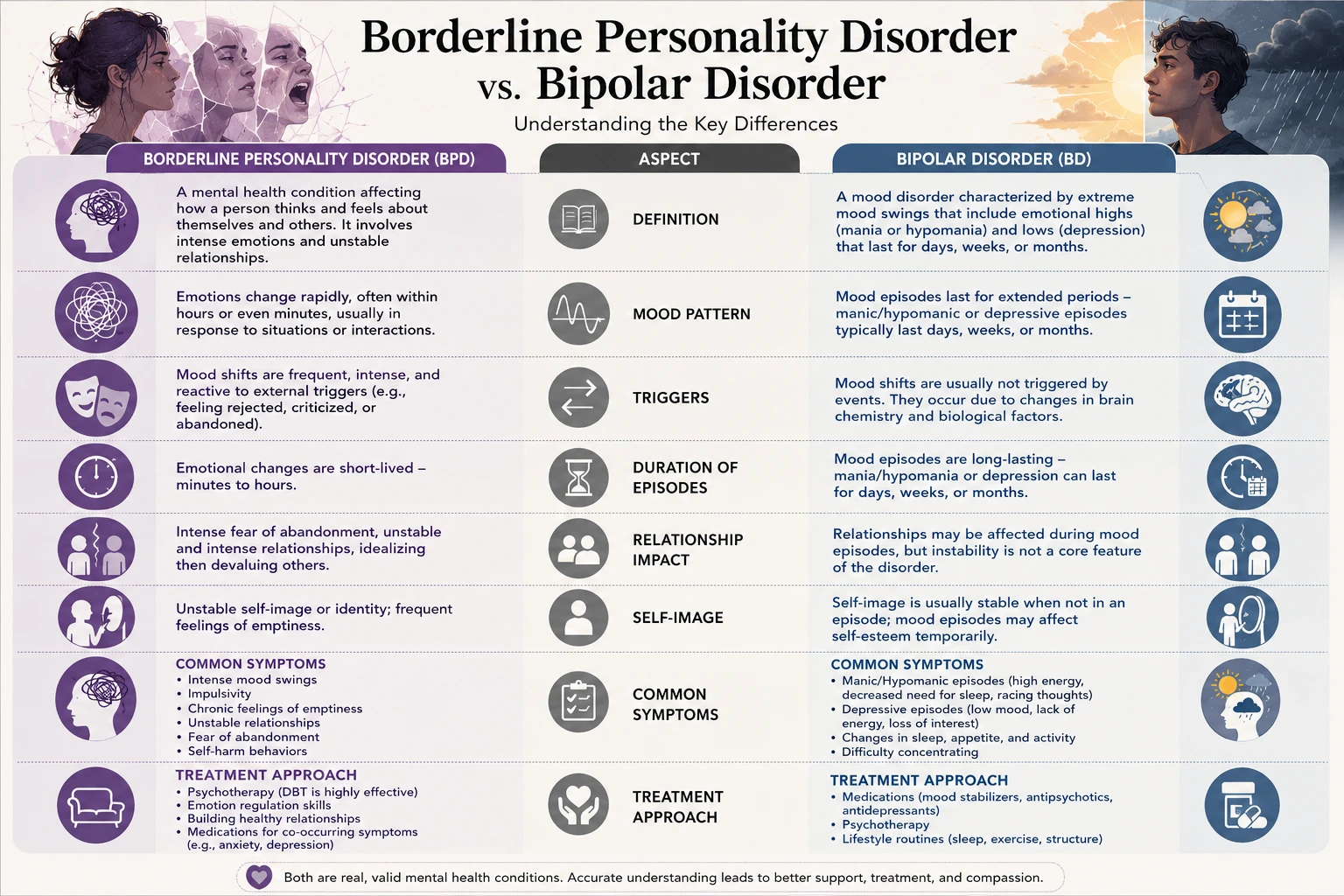
A visual guide to the key differences between Borderline Personality Disorder and Bipolar Disorder. Both involve intense mood states, but their patterns, triggers, and treatments are fundamentally different.
| Factor | BPD Borderline Personality Disorder | Bipolar Bipolar Disorder |
|---|---|---|
| Mood Episode Duration | Hours to a day. Rapid shifts, often multiple within one day. | Days to weeks or months. Distinct manic and depressive episodes. |
| What Triggers Mood Changes | Almost always interpersonal: a perceived rejection, criticism, or abandonment. Mood responds to the environment. | Often internal, biological. Not necessarily triggered by external events. Can come from nowhere. |
| The Nature of "Highs" | Intense positive emotions when feeling connected, loved, or validated. Not true mania. | Distinct manic episodes with reduced sleep need, grandiosity, racing thoughts, and often no distress at the time. |
| Fear of Abandonment | Central, defining feature. The organising fear of the disorder. | Not a core feature. Present only if BPD co-occurs. |
| Identity Instability | Core feature. Unstable self-image, values, and goals. | Identity typically stable between episodes. |
| Self-Harm | Common, often as emotional regulation. Typically ego-dystonic (the person hates doing it). | Less commonly a feature. More likely during severe depressive episodes. |
| Primary Treatment | Dialectical Behaviour Therapy (DBT) and other specialised psychotherapies. Medication is adjunctive. | Mood-stabilising medication (lithium, valproate) is the primary treatment. Therapy is important but adjunctive. |
| Medication Response | Medication does not treat BPD directly. It can help specific symptoms like depression or anxiety. No approved medication for BPD as a whole. | Mood stabilisers are highly effective for many people. Medication is the cornerstone of treatment. |
| Can They Co-Occur? | Yes. BPD and bipolar disorder can be diagnosed in the same person. This is not uncommon and requires careful, differentiated treatment planning. | |
The core question that helps differentiate them: are the mood changes happening in response to an interpersonal event? BPD says almost always yes. Bipolar says not necessarily.
On distinguishing BPD from bipolar disorder in clinical practiceHow to Support Someone With Borderline Personality Disorder
If someone you love has BPD, the first thing to understand is that their behavior is not designed to hurt you. It is the product of a nervous system that experiences emotion more intensely than most, that has learned to regulate those emotions through whatever means were available, and that is genuinely terrified of the thing it most needs: close, reliable connection. That context does not mean you are not affected. You are. But it changes what effective support looks like.
What Genuinely Helps
- Learn about the disorderUnderstanding what BPD is, how emotional dysregulation works, and why the splitting and abandonment fears manifest the way they do changes your experience of the behavior. You stop taking it personally and start seeing it clearly. This is not passive acceptance. It is the essential first step.
- Stay consistent and predictableThe BPD brain is hypervigilant to threat and change. Consistent responses, showing up when you say you will, following through, not making threats you do not intend to keep, provide the environmental stability that the person's nervous system is constantly scanning for. Inconsistency, even well-intentioned, amplifies the fear.
- Validate emotion without reinforcing behaviorThis is the most important and most difficult skill. "I understand you feel terrified right now" validates the emotion. "Sending me 40 messages is still not okay" maintains the boundary. Both can be true simultaneously. DBT teaches this skill specifically to family members of people with BPD.
- Set limits, not ultimatumsLimits are about what you will and will not do, not threats about what will happen to the relationship. "I can't continue this conversation when voices are being raised. I will come back when things have calmed down" is a limit. "If you don't stop I'm leaving you" is an abandonment trigger. The difference matters enormously.
- Get support for yourselfPartners, parents, and siblings of people with BPD frequently carry significant secondary trauma, anxiety, and exhaustion that goes unnamed and unaddressed. Your wellbeing matters. Family therapy specific to BPD, or individual counselling for yourself, is not disloyalty to the person you love. It is what makes sustained support possible.
What Makes Things Worse
- Dismissing or minimising their feelings"You're being dramatic" or "that's nothing to be upset about" are among the most counterproductive responses possible. They confirm the person's deepest fear: that their inner world is invalid, that they are too much, that they will ultimately be rejected for what they feel. Invalidation is a core driver of BPD escalation.
- Engaging in escalated argumentsWhen someone with BPD is in emotional flood, the prefrontal cortex, the part of the brain that allows rational conversation, is genuinely less accessible. Arguing when someone is flooded is not going to resolve anything. Calm, brief validation and stepping back until the wave passes is more effective than trying to reason in the moment.
- Walking on eggshells indefinitelyAdjusting everything to avoid triggering the person teaches the BPD brain that its fears and reactions are valid and effective. It also destroys your own quality of life. Reasonable, consistently communicated limits are kinder than perpetual accommodation.
If You Have Borderline Personality Disorder: How to Cope and Build a Different Life
If you are reading this section, you either suspect you have BPD or have been diagnosed. Either way, the most important thing to say first is this: the way you experience the world, the intensity, the fear, the emptiness, the desperate desire for connection alongside the terror of it, is real. It is not a character flaw. It is a pattern that developed for understandable reasons and that, with the right help, can change.
Getting an Accurate Diagnosis
BPD can only be diagnosed by a qualified mental health professional through a clinical interview and sometimes formal assessment. In India, this means a clinical psychologist or psychiatrist. The diagnostic process should take into account your full history, not just your current presentation, and should explicitly rule out other conditions, particularly bipolar disorder, with which BPD is frequently confused. If you have received a bipolar diagnosis and the treatments have not helped, it is worth seeking a second opinion that specifically evaluates for BPD.
Building Self-Awareness Around Your Triggers
One of the most immediately practical things anyone with BPD can begin to do is to map their own trigger-reaction sequences. What specific situations, people, words, or contexts tend to precede the most intense emotional reactions? Interpersonal rejection and criticism are the most common triggers, but the specific triggers are personal. Naming them, outside of a crisis, gives you a tiny window of agency. Not to prevent the feeling, but to recognise it earlier and respond with a skill rather than a reflex.
T — Temperature: Hold ice cubes, splash cold water on your face, or take a cold shower. The cold water reflex activates the parasympathetic nervous system and can reduce emotional intensity within seconds.
I — Intense Exercise: Run, jump, do push-ups. Intense physical activity burns off the cortisol and adrenaline that are flooding your body during emotional crisis.
P — Paced Breathing: Breathe out longer than you breathe in. A 4-count inhale and 6 to 8-count exhale activates the vagal brake and reduces heart rate.
P — Paired Muscle Relaxation: Tense and release each muscle group progressively. Releases physical tension that is amplifying the emotional experience.
Learning to Tolerate Uncertainty in Relationships
The fear of abandonment is the engine of most BPD-related interpersonal crises. Tolerating the uncertainty of "they have not replied and I do not know why" without immediately acting on the fear is a skill that can be built. It begins with recognising the moment the fear activates, naming it out loud or in writing, and delaying the response by even ten minutes. Over time, this window of tolerance expands. Not completely. But enough to change the pattern.
Treatment for Borderline Personality Disorder: What Actually Works
BPD has a reputation in mental health circles for being difficult to treat. This reputation is partly historical, partly a reflection of the therapeutic challenges the disorder presents, and significantly outdated. With the right treatment approach, approximately 75 percent of people with BPD show significant improvement, and many go on to live with minimal BPD symptoms or in full remission.
Dialectical Behaviour Therapy (DBT): The Gold Standard
DBT was specifically designed for BPD by Marsha Linehan and remains the most extensively validated treatment for the condition. A comprehensive 2024 review in World Psychiatry confirmed DBT's superior outcomes over general psychiatric management for BPD across multiple studies. DBT works across four skill modules: mindfulness, distress tolerance, emotional regulation, and interpersonal effectiveness. These are not abstract concepts. They are concrete, teachable skills with specific techniques that change how the person responds to intense emotional states.
Standard DBT includes individual therapy sessions, group skills training, and phone coaching between sessions. A 2024 naturalistic study comparing 8-week and 12-week DBT programmes both showed significant improvements in BPD-specific symptoms and depression, with effect sizes of 1.16 to 1.79, which are substantial in clinical terms. DBT is not a short-term intervention. Full programmes typically run for six months to a year.
Schema Therapy
Schema therapy addresses the deep, early emotional patterns, called maladaptive schemas, that underlie BPD. It is particularly effective for people whose BPD is rooted in childhood trauma or neglect. Schema therapy works more slowly and at a deeper level than DBT, exploring the origins of the patterns rather than primarily building regulation skills. Many people benefit from a combination of DBT skills for crisis management and schema therapy for longer-term healing.
Medication
No medication is specifically approved for BPD as a whole condition. Medication may be prescribed to address specific symptoms, such as antidepressants for depression, low-dose antipsychotics for dissociation, or mood stabilisers for impulsivity. Medication is adjunctive to therapy, not a substitute for it. People with BPD who receive medication alone without psychotherapy have consistently poor outcomes.
Borderline Personality Disorder in India: The Landscape
In India, BPD occupies a particularly difficult position. Personality disorders in general carry more stigma than mood disorders. The traits of BPD, the emotional intensity, the interpersonal instability, the impulsivity, are most commonly labelled in Indian families as "drama," "overreacting," "immaturity," or "attention-seeking." This labelling delays diagnosis and causes the person to internalise shame rather than access help.
DBT-trained therapists are scarce in India. The majority are concentrated in metros, specifically Delhi, Mumbai, and Bengaluru. Outside these cities, access to BPD-specific treatment is extremely limited. Online therapy has begun to fill this gap but the supply of qualified DBT practitioners remains well below the need. At Vaishalya Healing in Palampur, we offer BPD-informed counselling and psychoeducation both in person and online across Himachal Pradesh and India, drawing on CBT, DBT-informed approaches, and schema therapy principles.
If someone in your family has been diagnosed with BPD or you suspect they may have it, the most important thing you can do is resist the urge to label their behavior as moral failure. Seek professional assessment. Seek family counselling that is specifically informed by what BPD is and how it functions. And reach out to a professional who understands the condition rather than simply the symptom. You do not need to be in a metro city to access this support. Online counselling makes it available wherever you are.
Common Questions About Borderline Personality Disorder
The most practical distinction is in what triggers mood changes and how long they last. In BPD, mood shifts are almost always triggered by interpersonal events, a rejection, a perceived abandonment, a critical comment, and they typically last hours, not days. In bipolar disorder, mood episodes, both manic and depressive, can arise without a clear external trigger, last days to weeks, and follow a biological rhythm. Identity instability, fear of abandonment, and self-harm are core features of BPD and not of bipolar disorder. Treating BPD with mood stabilisers alone, as bipolar is often treated, is ineffective and misses the point entirely.
The word "cured" is less accurate than "remission" or "significantly improved." Research shows that approximately 75 percent of people with BPD show major symptom improvement over time, particularly with Dialectical Behaviour Therapy. Long-term longitudinal studies have found that many people who met full BPD criteria in their twenties no longer meet criteria in their thirties and forties. The disorder tends to be most severe in early adulthood. With treatment, the trajectory is genuinely positive for most people. The goal is not the absence of all emotional intensity, which is a permanent feature of who the person is, but the ability to manage it without it running or ruining their life.
Everyone experiences intense emotions sometimes. BPD is distinguished by the pervasiveness, the consistency, and the functional impact of the pattern. If emotional intensity is significantly disrupting your relationships, your career, your self-image, and your ability to manage daily life, across multiple contexts and over years rather than in one specific stressful period, that is worth assessing professionally. An honest way to begin is to read the DSM-5 criteria and reflect carefully on whether you recognise five or more as persistent, long-standing patterns. A clinical assessment by a qualified psychologist is the only definitive way to know.
Carefully and without a diagnosis attached. You cannot and should not diagnose someone yourself. What you can do is express concern about their wellbeing, not their behavior. "I love you and I've noticed you seem to be in a lot of pain a lot of the time. I wonder if it would help to talk to someone" is far better received than "I think you have BPD." If the person is resistant, continue to focus on impact and your concern for their suffering rather than their effect on you. And speak to a professional yourself first, who can guide you on how to approach the conversation most effectively.
BPD is diagnosed in women more frequently than in men, with women representing approximately 75 percent of BPD diagnoses in clinical settings. However, many researchers believe this reflects diagnostic bias rather than a genuine gender difference in prevalence. Men with BPD are more likely to be diagnosed with antisocial personality disorder or substance use disorder because their BPD expression is externalised: anger, substance use, risk-taking, rather than the internalised self-harm and emotional volatility that is more typically recognised as BPD in women. BPD occurs across all genders and gender identities, and all presentations deserve appropriate assessment.
Having BPD does not excuse abusive behavior. The disorder explains the intensity and the pattern. It does not make abuse acceptable or something you are required to tolerate. Your safety and wellbeing are not secondary to your partner's disorder. If you are experiencing emotional, verbal, or physical abuse, please seek support for yourself, whether through individual counselling, a crisis helpline, or a trusted person. A relationship with someone with BPD can be challenging and rewarding with the right support on both sides. A relationship that is consistently abusive is a different situation that deserves honest assessment, with professional support, about what is sustainable and safe for you.
DBT-trained therapists in India are most concentrated in Delhi, Mumbai, and Bengaluru. Online therapy has significantly expanded access across the country. Vaishalya Healing in Palampur, Himachal Pradesh, offers BPD-informed counselling both in person and online across India, drawing on CBT, DBT-informed approaches, and schema therapy principles. NIMHANS in Bengaluru is a government resource with specialist outpatient services. iCall (9152987821), run by TISS, can provide referrals. When seeking a therapist for BPD specifically, ask directly whether they have experience with BPD, whether they are familiar with DBT, and whether they have worked with personality disorders previously.
Yes, DBT is the most extensively researched and validated treatment for BPD. Multiple randomised controlled trials have demonstrated its superiority over general psychiatric management for reducing suicidal behaviour, self-harm, hospitalisation rates, and emotional dysregulation in people with BPD. A 2024 comprehensive review in World Psychiatry confirmed DBT's position as the first-line treatment for BPD. A study comparing 8 and 12-week DBT programmes both showed effect sizes of over 1.0 on BPD-specific symptoms, which is clinically significant. DBT requires commitment: full programmes typically run for six to twelve months. But the outcomes data is among the most encouraging in all of personality disorder treatment.
Borderline Personality Disorder Is Real, Painful, and Genuinely Treatable
If you have read this article to the end, you are taking this seriously. Whether you are reading it for yourself, for someone you love, or because a diagnosis has been recently received, the seriousness is warranted. BPD is a significant condition. It causes real and profound suffering. And it changes, over time and with the right support, in ways that are genuinely meaningful.
The emotional intensity that drives BPD is not who the person is. It is a pattern that developed in a nervous system shaped by specific genetics and specific experiences. That pattern is not fixed. It responds to the right kind of support. The 75 percent improvement rate is not a small number. It represents real lives, real relationships, and real freedom from what can feel like an inescapable internal storm.
If you or someone you love needs support, whether to understand a diagnosis, to begin therapeutic work, or simply to have a confidential first conversation, we are here. In person at Vaishalya Healing in Palampur, Himachal Pradesh, and online across India.

Borderline Personality Disorder responds to the right help.
That help is available.
At Vaishalya Healing in Palampur, we work with individuals navigating BPD, personality-related challenges, emotional dysregulation, and the families who support them. In person and online across India. The first step is always just a conversation.
Book a Free Consultation Explore Our ServicesVisit the Clinic
Vaishalya Healing, Palampur
Himachal Pradesh, India
In-person and online sessions
Online Counselling India
BPD-informed counselling accessible from anywhere in India. Confidential and qualified.
Counseling
Help Center
Contact Us
Office Timings: Monday to Saturday, 10:00 AM to 5:00 PM
Address: Mohal Gugga Saloh
Tehsil Palampur, Distt. Kangra
Himachal Pradesh - 176102
Email: help@vaishalyahealing.com
Phone/WhatsApp: +91 7018148449