
NEET Cancelled. Recession Coming. No Jobs. How to Handle Anxiety When Everything Feels Out of Control
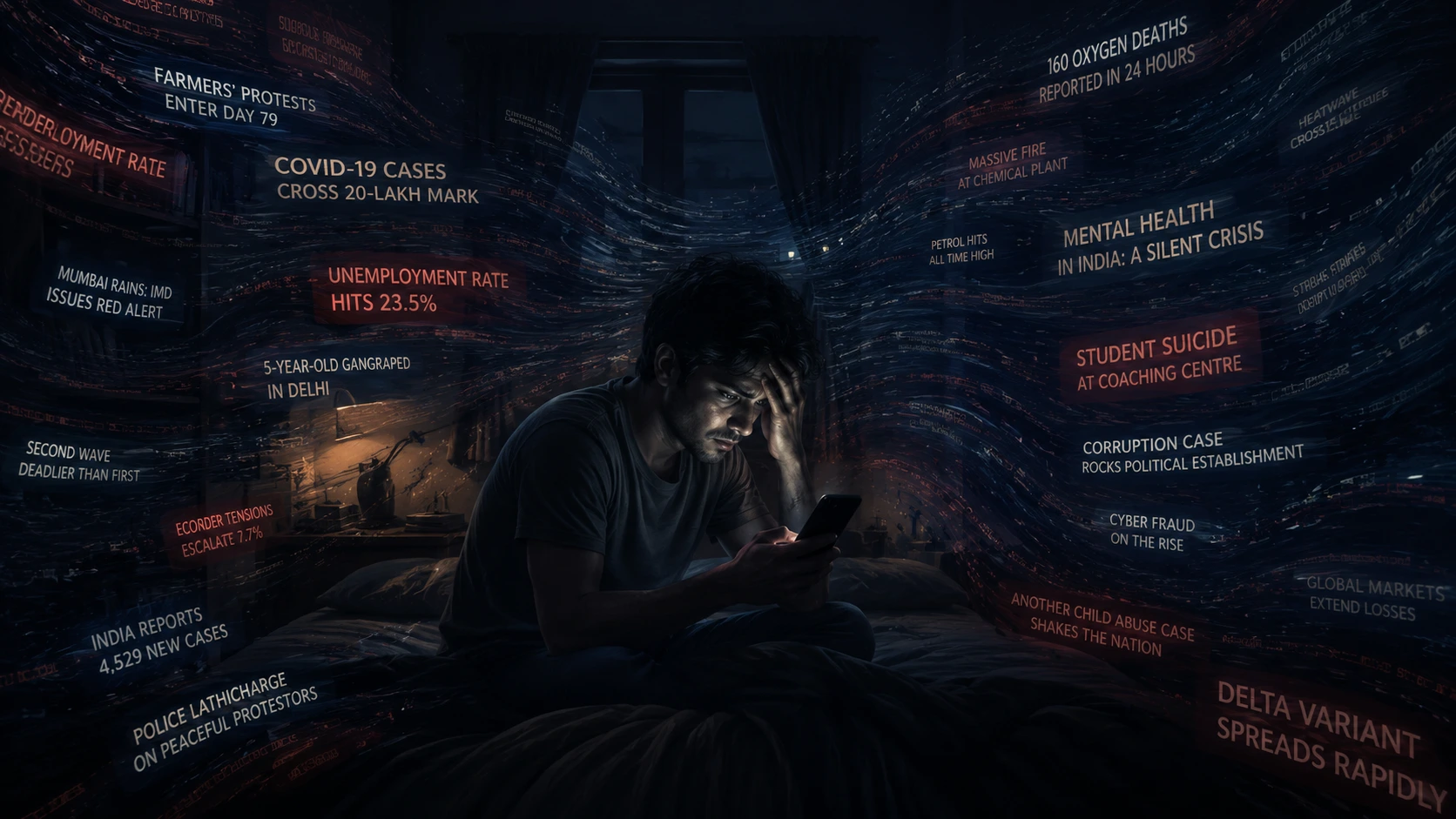
You spent a year preparing. Or two. Or three. And then one morning, you woke up to news that the exam was cancelled. Or you graduated, sent out 80 applications, and the market dried up. Or the news cycle is a loop of war, recession, and layoffs and you cannot sleep properly anymore. If any of this sounds like your life right now, this article is for you. Not the generic "practice gratitude and drink water" kind. Actually for you.
Let us start by naming what is happening right now, because most people are trying to manage anxiety they have not even fully acknowledged.
Over 22 lakh students preparing for years, some for the second or third time, woke up to a notification that everything is postponed. Again. No date, no clarity.
Youth unemployment at nearly 15 percent. Entry-level hiring slowing down. Graduates competing for roles that barely pay. The job market no longer rewards just working hard.
The Strait of Hormuz disruption hit India's oil imports, pushed the rupee down, and sent markets into a spiral. Things happening thousands of kilometres away are landing in your monthly budget.
All three of these things are happening simultaneously to the same generation. Students who studied through COVID, gave exams in hybrid chaos, graduated into a pandemic economy, and are now facing this. It is not a coincidence that anxiety numbers among Indian youth are at their highest in recorded history. It is a direct response to a world that keeps pulling the ground from under their feet.
First: Your Anger, Confusion, and Exhaustion Are Completely Valid
Before any strategy or tip, this needs to be said plainly: you are not overreacting.
When the NEET 2026 cancellation was announced, students across the country described feeling numb, devastated, and betrayed. A student in Kota said: "You prepare every single day with only one thing in mind. When it suddenly gets cancelled, it feels like all the hard work is left hanging in the air." Another said she cried for three days straight. A third sought medication because the panic attacks became too much to handle alone.
These are not weak responses. These are human responses to a genuinely destabilising event. The same goes for the anxiety around job searches and economic uncertainty. When the system you were told to trust, the exam system, the job market, the economy, fails you or moves unpredictably, your nervous system goes into threat mode. That is not a personality flaw. That is biology.
"I feel like I did everything right. I studied, I didn't take shortcuts, I listened to my parents. And the result is still chaos. At some point you start wondering whether effort even matters." This thought is extremely common right now. And it makes complete sense.

The problem is not that you are feeling these things. The problem is what happens when you stay there too long, when the anger curdles into hopelessness, when the anxiety stops being a signal and starts becoming the whole story. That is where the work begins.
Connecting the Dots: Why Anxiety Feels Linked to Everything Right Now
One reason anxiety spikes so badly in situations like this is that multiple stressors arrive at the same time and feel connected. The NEET cancellation feels linked to the larger sense that systems do not care about you. The job market anxiety feels linked to global economic instability. The news from West Asia feels like it is somehow related to the offer letter that did not come. Your brain is connecting dots that may not all be directly related, but the feeling is very real.
Psychologists call this generalisation. One specific stressor stops feeling specific. It starts feeling like evidence of a broader truth: that things will not work out for you. That the world is rigged. That effort is pointless. This is the moment catastrophic thinking takes over, and it does so quietly, through the back door, disguised as rational analysis.
The brain under stress does not distinguish between "the NTA failed to conduct an exam" and "I am a failure." When systems collapse, our nervous systems personalise it. That is the trap.
On how systemic failures become internal narrativesUnderstanding this does not fix it. But it gives you something crucial: a slight distance between what happened and what you are telling yourself it means. And that distance is where every useful strategy lives.
The Most Useful Mental Shift: Separating What You Can Control From What You Cannot
This sounds obvious. It is not easy. But it is the single most effective way to reduce anxiety in situations of systemic uncertainty. Psychologists call it working with your locus of control, a term coined by researcher Julian Rotter in the 1950s that has been validated by decades of research since.
The idea is simple: your energy is finite. Every minute you spend worrying about something you cannot change is a minute taken away from something you can. When you are aware of which category a thought belongs to, you can redirect more deliberately.
- Whether NTA reschedules the exam and when
- Global oil prices and the West Asia conflict
- Whether a company decides to freeze hiring
- How the economy performs over the next year
- What your relatives think about your situation
- The decisions made by government or examination boards
- How other students are using this time
- Your sleep schedule and when you wake up
- What you study tomorrow morning
- How many applications or preparation hours you log this week
- Whether you talk to someone when things get heavy
- How much news you consume and when
- Whether you keep a daily routine or let days blur
- Who you spend your time around

The shift here is not about pretending the external chaos does not exist. It absolutely does. It is about deliberately choosing not to build your daily emotional state on things that will not respond to your worry. The exam date will be announced when it is announced. The market will do what it does. Your sleep schedule and your preparation hours are yours. That is where your real power sits, and it is more significant than it sounds.
The 3-Column Thought Reset That Psychologists Actually Use
When anxiety spikes, the thoughts that follow are almost always catastrophic. Not just negative, but absolute. "My entire future is ruined." "I will never get into a good college." "No one is hiring and I will be stuck forever." These thoughts feel true in the moment. They are rarely accurate.
Cognitive Behavioural Therapy uses a simple tool called a Thought Record to interrupt this cycle. The version here is stripped down to three columns, easy enough to use on a piece of paper or the notes app on your phone, even when you are mid-anxiety.
Here is how it works in practice:
| Column 1: The Catastrophic Thought | Column 2: Reality Check Questions | Column 3: The Balanced Version |
|---|---|---|
| "My entire future is ruined because NEET got cancelled." | Is this the only path? Have others faced setbacks and recovered? Is this permanent? | "This is a genuinely painful delay. The knowledge I built is still there. The exam will happen. My preparation is not wasted." |
| "Nobody is hiring. I am going to be unemployed forever." | Is the market frozen everywhere? Are there sectors still growing? What have I not tried yet? | "The market is difficult right now. That is real. It does not mean there are zero opportunities. I need to look harder and in different places." |
| "I studied for years and it meant nothing." | Did the studying actually add nothing? Will this situation always be the outcome? | "The system failed this time, not my work. The skills and discipline I built still exist. I need to find the right context for them." |
| "Everything in the world is falling apart and I have no future." | Is everything falling apart or are some things difficult right now? Has India's youth recovered from hard periods before? | "Genuinely hard things are happening. They will not all last at the same intensity. I can focus on one thing I can do today." |
The goal is not to gaslight yourself into positivity. The goal is accuracy. A catastrophic thought is not more true because it is more intense. Running it through these three columns takes about three minutes and consistently reduces the physical intensity of the anxiety response.
Try it right now: Think of one thought that has been repeating in your head about your current situation. Write it in the first column. Ask yourself: is this the absolute worst case or the only possible outcome? What would a trusted friend say to challenge it? Now write what a more balanced version would sound like. That third version is not denial. It is the truth that anxiety was hiding from you.
10 Ways to Handle Anxiety When Everything Feels Out of Control
These are not generic wellness tips. These are evidence-backed actions that directly address the specific kind of anxiety that comes from uncertainty and loss of control.
How to Actually Cope When the Plan Keeps Changing
The honest truth about coping with systemic uncertainty is that you cannot find stability in the thing that is moving. You have to find it in yourself. That sounds like a motivational poster and it is annoying to read when things are genuinely falling apart, so here is what it actually means in practice.
Think of Arjun, a 23-year-old in Chandigarh who received his offer letter and then watched it get rescinded when his company froze hiring because of the market. He spent three weeks completely derailed, refreshing job portals sixteen hours a day and getting more anxious with each application. What finally shifted was not a better job opportunity. It was the decision to stop organising his day around the job hunt alone and to rebuild one other anchor: a course he was doing for skill development and a morning run he had abandoned. Neither of those fixed the job market. But they gave him enough stability to think clearly and interview better.
Or think of Kavya, a NEET aspirant who found out about the cancellation the same morning she had done her last revision. She describes feeling "erased." What helped her was not getting back into her syllabus immediately. It was two days of doing absolutely nothing guilt-free, then writing out what she actually knew about the subject she had just studied. She re-read her own notes and realised the knowledge was there. That was the turning point: not the system functioning again, but her own evidence that the work had actually happened.
These are not exceptional people with special resilience. They are ordinary people who found one small anchor and held onto it long enough for the initial wave of anxiety to reduce. That is the real coping mechanism. Not eliminating the uncertainty, just building something stable enough inside it to function.
One Thing That Will Absolutely Make This Worse: Nasha
Turning to alcohol, drugs, or any substance right now is not coping. It is borrowing time you do not have.
In states like Punjab and Himachal Pradesh, where this blog's primary audience lives, substance use among young people under stress is a documented and serious pattern. The data from de-addiction centres across the region shows that many people who developed serious dependencies started during exactly the kind of high-uncertainty, high-pressure period you may be in right now.
The logic feels straightforward in the moment: the anxiety reduces. The noise quietens. You sleep. But anxiety treated with a substance does not get resolved. It gets paused and then amplified. When the substance wears off, the anxiety returns, and now you also have a dependency building alongside it. Within months, the original problem and the substance problem are both demanding attention, and the substance problem is louder.
If you are using any substance to manage what you are feeling right now, or if someone around you is, please reach out. Not after it gets worse. Now. The national de-addiction helpline (1800-11-0031, toll free, 24 hours) is a genuine first step. So is a conversation with any trusted adult or counsellor.
How Counselling Actually Helps With Anxiety When Everything Feels Out of Control
There is a version of counselling that people imagine: lying on a couch describing your childhood while someone nods. That is not what modern counselling looks like, especially for the kind of situation you may be in right now.
When you are dealing with anxiety driven by systemic uncertainty, a good counsellor does several specific things that are genuinely difficult to do alone. They help you identify which of your current thoughts are accurate and which are distortions being created by an overloaded nervous system. They give you tools for the specific kind of catastrophic thinking that comes with high-stakes situations. They help you separate what is happening from what you are making it mean about yourself. And they give you a space to be completely honest without managing how the other person will react.
That last part matters more than people realise. When you are under this kind of pressure, the people closest to you are often also anxious about your situation. Parents are scared. Friends are managing their own version of the same chaos. Talking to them helps, but you are often also managing them while you talk. Counselling removes that layer. You can say the most catastrophic thought in your head without worrying what it will do to the person across from you.
At Vaishalya Healing in Palampur, Himachal Pradesh, we work with students and young adults navigating exactly this kind of multi-directional pressure, exam uncertainty, career anxiety, the feeling of being stuck in a world that is moving too fast. Sessions are available in person and online across India. You do not need to be in crisis to reach out. You need to be in enough discomfort that it is affecting your daily life. That is sufficient.
If you are dealing with anxiety that is making it hard to study, sleep, or function, you can also read more about signs of anxiety you might not realise you have, which covers how this kind of background distress shows up in ways people often miss entirely.
Real Questions About Anxiety When Everything Feels Out of Control
Do not start with the syllabus. Start with evidence. Spend one hour re-reading notes or solving problems from a topic you already know well. The goal is not to learn something new. The goal is to remind yourself that the preparation actually happened and is still there. Motivation after a shock does not come first and then lead to action. It comes after small action. Start with something you can complete, even if it is small, and motivation tends to follow rather than precede that first step.
What you are feeling is understandable given what the market is doing right now. Youth unemployment at roughly 15 percent means one in six young people actively seeking work are not finding it. You are not uniquely failing. You are in a difficult structural moment. The distinction matters because hopelessness about yourself as a person responds differently to action than hopelessness about a market cycle. The market will shift. Your response in the meantime, what skills you are building, what options you are exploring, what your mental state will be when the market opens up again, is what you can actually influence.
Parent pressure during uncertain times almost always comes from fear, not from a belief that you are inadequate. That does not make it easier to receive. The most useful approach is to give them one specific update regularly, something concrete you are doing, so the anxiety has somewhere to land rather than coming out as pressure. Beyond that, reducing how many daily check-ins you have about the situation tends to help more than long explanations of why the pressure is counterproductive. And if the anxiety from family pressure is significant enough to affect your functioning, that is worth mentioning to a counsellor.
Three things that work based on research rather than general wellness advice. First, a worry window: set a specific 20-minute period in the late afternoon, not evening, where you are allowed to think about and write down every worry. This trains your brain to contain the worrying rather than spreading it through the night. Second, a fixed wind-down sequence starting 45 minutes before bed: dim lights, no phone screen, something non-stimulating to read. The routine signals the nervous system to begin the shift toward sleep. Third, if you wake at 2 or 3am with anxiety, get up and write the thought down rather than lying in bed fighting it. The act of externalising it removes some of its power.
The disruption in the Strait of Hormuz, the key shipping route through which a significant portion of India's oil imports travel, pushed fuel costs up, put pressure on the rupee, and contributed to stock market volatility in early 2026. These translate to higher costs of living, tighter company budgets, and delayed hiring decisions. This is a real and concrete chain. The important distinction is that this is a macro pressure affecting the entire economy, not a personal failing. Knowing this does not fix the anxiety, but it helps redirect it: the problem is systemic, not personal, and systemic problems change over time.
Research consistently shows that online counselling is as effective as in-person sessions for anxiety, stress, and most non-crisis mental health concerns. For students or young adults in smaller towns across Himachal Pradesh where qualified mental health professionals are scarce, online sessions remove a significant barrier. Vaishalya Healing in Palampur offers both in-person and online counselling for students, young adults, and families. If anxiety or uncertainty is affecting your daily life, a first session is a low-stakes way to find out whether it would help.
You are not. The reason it feels that way is that the people around you are also managing, and managing often looks like hiding. A student who was interviewed after the NEET 2026 cancellation said she felt completely alone until she found out her entire study group had cried or stopped sleeping that week. Social media compounds this because what is shared is rarely what is felt. The anxiety you are experiencing at a time of genuine systemic disruption is a proportionate human response, not evidence that you are weaker than everyone else. Most people are feeling some version of the same thing and talking about it with none of them.
The System Failed. That Is Not the Same as You Failing.
The NEET cancellation, the slow job market, the economic uncertainty that seems to keep compounding, none of this is your fault. You prepared. You showed up. You did what was asked of you. The systems around you did not hold their end of the deal.
That betrayal is real and worth being angry about. The anger just cannot be the place you live, because it costs too much energy and takes up space that belongs to the things you can still do.
The knowledge you built is still there. The work you put in does not disappear because a date was cancelled. The skills you are developing during a difficult job market are real. The resilience you are building right now, even if you cannot feel it, is the thing that will matter most when the situation opens up again. And it will open up again. That is not empty reassurance. It is what every previous generation of Indian youth who faced structural disruption eventually discovered.
If you need someone to talk to while you find your footing, we are here.

If anxiety is making it hard to function,
that is enough reason to reach out.
At Vaishalya Healing in Palampur, we offer counselling support for students facing exam uncertainty, young adults dealing with career anxiety, and anyone trying to hold it together when the world is not cooperating. In person and online across India.
Book a Free Consultation Explore Our ServicesVisit the Clinic
Vaishalya Healing
Palampur, Himachal Pradesh
In-person and online sessions available
Immediate Support
National Mental Health Helpline: iCall 9152987821
De-Addiction Helpline: 1800-11-0031 (Toll free, 24 hours)
Related Reading
More on anxiety, stress, and mental health for young people in India:
Counseling
Help Center
Contact Us
Office Timings: Monday to Saturday, 10:00 AM to 5:00 PM
Address: Mohal Gugga Saloh
Tehsil Palampur, Distt. Kangra
Himachal Pradesh - 176102
Email: help@vaishalyahealing.com
Phone/WhatsApp: +91 7018148449