

10 Signs of Anxiety You Might Not Realize You Have
We often picture anxiety as something loud and obvious. Someone shaking, panicking, or unable to speak. In reality, anxiety is usually far quieter than that. It slips into routines, habits, thought patterns, and body sensations so gradually that many people do not recognize the signs of anxiety at all. If you often feel uneasy but cannot quite explain why, what follows might begin to make some things clearer.
For some, anxiety shows up as constant overthinking. For others, it hides behind perfectionism, physical discomfort, restlessness, or an exhausting need to keep everything under control. Anxiety does not always announce itself. Sometimes it disguises itself as normal stress, personality, or simply being a careful person.
Sign 1: Common Signs of Anxiety Often Start With Looking Fine on the Outside
You appear composed while carrying a lot inside
Masked anxiety is more common than most people realize
Many people assume that if anxiety were serious, everyone around them would notice. But anxious people are often extremely skilled at hiding how much they are carrying. Outwardly, you may seem composed, capable, and even cheerful. People may describe you as strong or reliable.
Inside, though, you might feel tense, overwhelmed, or afraid that your carefully controlled image could fall apart at any moment. This can feel like wearing a mask all day. At work, in social settings, or around family, you keep smiling, keep functioning, and keep pretending everything is under control. Underneath that performance, there may be a constant fear of being exposed, judged, or misunderstood. The effort it takes to look calm can become emotionally exhausting over time.

Signs of anxiety frequently hide in the ordinary moments of daily life, not just in obvious crisis situations.
Sign 2: You Fixate on Small Worries to Avoid Bigger Feelings
Small, manageable problems become a place to put bigger anxiety
Worry can be a distraction, not just a reaction
Anxiety often latches onto practical, everyday concerns because they feel easier to manage than deeper emotional pain. You may become preoccupied with whether you locked the door, sent a message correctly, reached an appointment on time, or remembered every detail of a plan. On the surface, these seem like ordinary worries.
But sometimes they are a distraction from larger questions you do not want to face. Maybe the real issue is loneliness, dissatisfaction in a relationship, fear about the future, or discomfort with the direction of your life. Your mind may choose small, solvable problems because they are less painful than sitting with emotional uncertainty. In that way, anxiety can quietly become a form of avoidance.
If you find yourself worrying intensely about something small while a larger issue sits unaddressed in the background, that pattern is worth paying attention to. It is not a character flaw. It is often how an overworked nervous system tries to protect itself.
Sign 3: Your Body Feels Wrong and You Immediately Fear the Worst
Physical signs of anxiety are frequently mistaken for medical illness
A fast heartbeat becomes a heart problem in the anxious mind
When anxiety activates the body's threat response, it can produce very real physical sensations. The heart may race. Breathing may feel shallow. The throat may tighten. Legs may feel weak. The stomach may turn. Dizziness may appear out of nowhere.
If you do not realize these are anxiety symptoms, it is easy to misread them as signs of something dangerously wrong. A fast heartbeat becomes a heart problem. A tight chest becomes a medical emergency. Lightheadedness becomes a fear of fainting or collapsing.
This often leads to constant self monitoring. You may keep checking your pulse, scanning your body, or replaying symptoms in your mind. The more you notice, the more alarming everything feels, and the cycle grows stronger with each round.
Anxiety does not just live in the mind. It lives in the body too, and some of the most confusing signs of anxiety are the ones that feel entirely physical.
On how anxiety manifests physicallySign 4: Unwanted Thoughts That Shock or Scare You
Intrusive thoughts are one of the most distressing signs of anxiety
Having a disturbing thought does not mean you want it to happen
One of the most distressing parts of hidden anxiety is intrusive thinking. These thoughts can be sudden, unwanted, and deeply disturbing. You might imagine something terrible happening while standing near a balcony. You may have a random violent thought while holding a kitchen knife. You may experience a bizarre or inappropriate mental image that feels completely unlike you.
What makes these thoughts so frightening is not just their content, but how alien they feel. People often assume that having such a thought means they secretly want it or are losing their mind. In reality, intrusive thoughts are often a sign of a highly stressed, overactive nervous system. The very fact that they upset you is evidence that they do not reflect your values or intentions. This is something a trained counselor or psychologist can help you understand and work through.
Sign 5: The World Starts to Feel Strange or Unreal
Feeling detached from reality is a recognized anxiety response
Disorientation and unreality can follow nervous system overload
Sometimes anxiety does not just create fear. It changes the way reality itself feels. You may suddenly feel detached from your surroundings, as though everything is slightly distant, muted, or artificial. Familiar places may feel unfamiliar. Your own reflection may seem odd. Time may feel distorted.
The experience can be unsettling enough to make you worry that something is seriously wrong with your mind. This sense of unreality, sometimes called depersonalization or derealization, can happen when the nervous system becomes overwhelmed. It is often the brain's way of blunting emotional overload. Although it feels deeply strange, it is not uncommon during periods of intense stress or anxiety, and it is not a sign that you are losing your grip on reality.
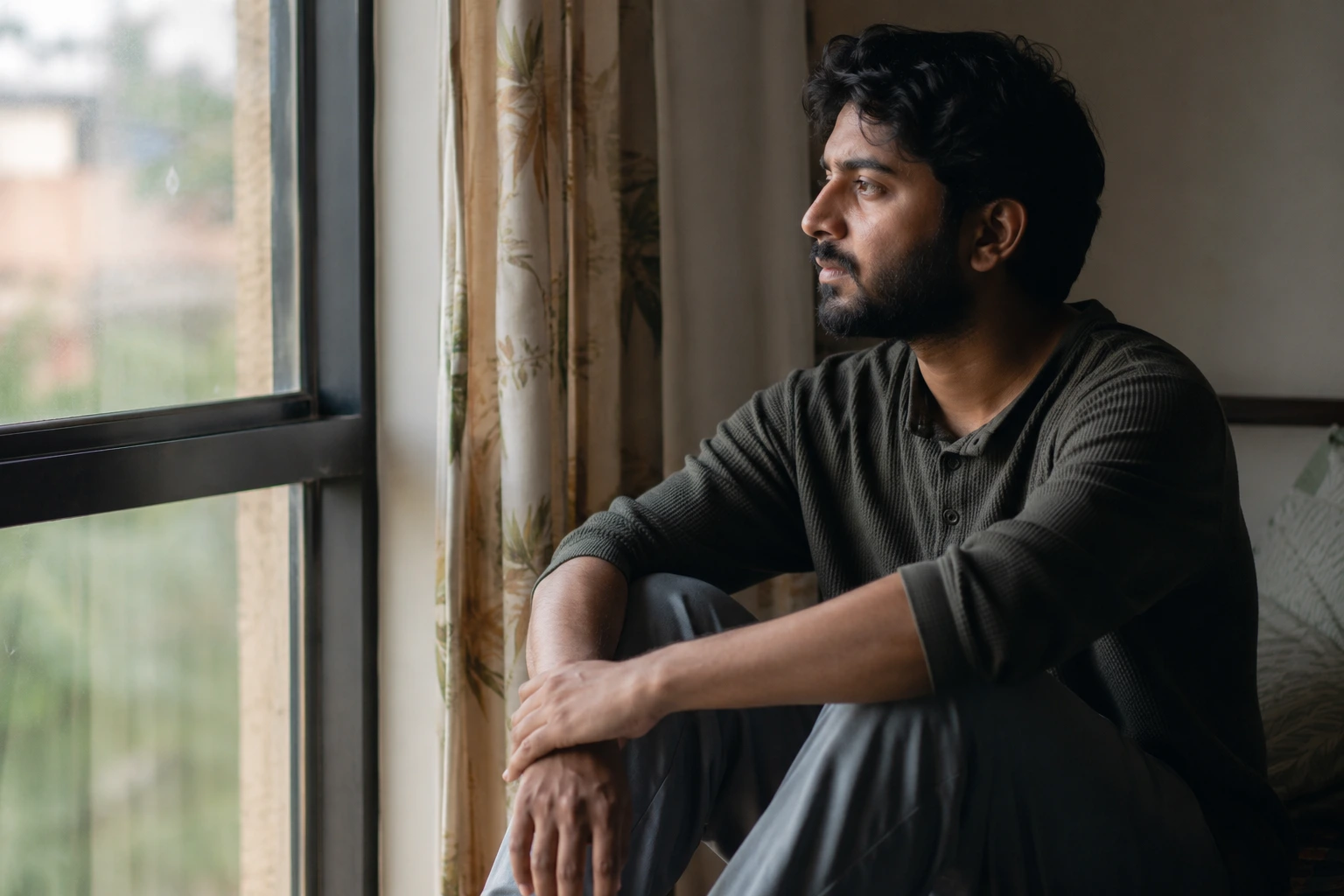
Feeling disconnected, lonely, or like things are slightly unreal can all be quiet signs of anxiety that often go unnamed.
Sign 6: Your Worry Is Tied to Harsh Self Judgment
Anxiety and self criticism often grow together quietly over time
When you expect the worst, worry starts to feel like protection
Sometimes anxiety is not only about external pressures. It can also grow from the way you silently speak to yourself. If you carry a deep sense of not being enough, your mind may start treating worry as a kind of protection. You may expect criticism, rejection, or disappointment before anything has even happened. Good moments may feel suspicious, as though something bad must be waiting just around the corner.
When self criticism becomes a habit, anxiety can begin to feel like anticipation rather than fear. You worry not only because something may go wrong, but because you have come to believe, somewhere underneath everything, that trouble is what you deserve. That inner logic can be painful and very hard to notice because it often feels completely normal after years of repetition.
A note on self criticism and anxiety: Chronic self criticism is not a personality trait you were born with. It is often learned, sometimes in childhood, sometimes through difficult experiences. And because it was learned, it can also be gently unlearned, with time, support, and the right kind of help.
Sign 7: Being Happy Makes You Nervous
Feeling uneasy during good times is a less obvious sign of anxiety
A nervous system in alert mode can struggle to trust calm
Many people want peace and joy, but for some anxious people, happiness itself can feel uncomfortable. When life gets calm, your mind may not relax. Instead, it may begin searching for the next problem. A good relationship may make you suspicious. A peaceful day may feel temporary. A pleasant phase of life may trigger the fear that something will soon ruin it.
Sometimes people unconsciously disrupt their own happiness because they are more familiar with tension than with ease. They may start unnecessary arguments, overwork themselves, or create pressure in situations that were finally beginning to feel safe. A nervous system that has lived in alert mode for too long can genuinely struggle to trust calm. It does not feel like peace. It feels like a gap before the next difficulty.
Sign 8: Your Life Slowly Shrinks Into a Few Safe Places
Avoidance is one of the most gradual signs of anxiety building over time
The comfort zone can quietly become a cage
Anxiety often teaches the brain to avoid whatever once felt uncomfortable. At first, this may seem helpful. You skip one event, avoid one route, or stay away from one situation that triggered stress. Relief comes quickly, and that relief reinforces the habit.
Over time, though, your world can begin to narrow. You may become more dependent on familiar places, familiar people, or familiar routines. New settings may feel threatening. Certain drives, social gatherings, errands, or conversations may start to feel impossible. What begins as caution can slowly turn into restriction. The comfort zone becomes smaller and smaller until it no longer feels like comfort. It begins to feel like confinement.
Sign 9: You Keep Gathering Information But Never Feel Certain
Constant research is one of the more hidden signs of anxiety
More information does not dissolve anxiety. It often feeds it.
An anxious mind wants certainty. It wants to remove risk, eliminate mistakes, and predict every possible outcome. That is why you may keep searching online, comparing options, rechecking details, or asking the same question in different ways. At first, this feels responsible. You believe that if you just know enough, you will finally feel calm.
But anxiety rarely settles after one answer. It usually demands another search, another opinion, another round of analysis. Instead of clarity, you end up with more confusion. Instead of confidence, you get mental exhaustion. The mind keeps spinning because it is trying to solve uncertainty with more and more information, even though uncertainty cannot be fully removed from life.
Sign 10: You Treat Life Like Constant Competition
Chronic comparison is a quiet but persistent sign of anxiety
When every moment becomes a ranking, rest becomes nearly impossible
Modern life makes comparison feel unavoidable. Success, appearance, productivity, and status are measured everywhere, and anxious people often absorb that pressure very deeply. You may feel as though every area of life is a test. Work, relationships, progress, and personal growth can start to feel like rankings rather than experiences.
If someone else is ahead, you feel behind. If you make a mistake, it may feel like a failure of identity rather than a simple human moment. This mindset can keep you in a constant state of low-level tension. It becomes harder to appreciate your own progress, harder to enjoy other people's success, and harder to stay present in your own life. The more you focus on winning, the less room there is for peace.
Common Questions About Signs of Anxiety
Yes, and this is more common than most people realize. Many signs of anxiety present without the obvious feeling of fear or nervousness. Instead, anxiety may show up as physical tension, irritability, difficulty concentrating, avoidance, or an overwhelming need to stay in control. People often live with these patterns for years without connecting them to anxiety at all.
Normal stress tends to have a clear cause and eases once the situation passes. Anxiety often persists even when there is nothing specific to worry about. It tends to be disproportionate to the situation, difficult to control, and present across many areas of life. If worry is affecting your sleep, relationships, work, or daily functioning regularly, it is worth speaking to a qualified counselor or psychologist to understand what is going on.
They can be. When the body's stress response activates, it produces very real physical sensations including a racing heart, tightness in the chest, shallow breathing, nausea, dizziness, and muscle tension. These are genuine physiological responses, not imagined ones. However, it is always worth ruling out any medical cause with a doctor, especially if symptoms are new or severe. Once a medical cause is excluded, these sensations are often traced back to anxiety.
Yes. Intrusive thoughts, sudden, unwanted, and distressing mental images or ideas, are very commonly linked to anxiety. They are not a sign that you want to act on what you imagined, or that you are dangerous or losing control. They are a sign that your mind is under significant stress and working in overdrive. A trained psychologist can help you understand and work with these thoughts, particularly if they are causing significant distress or interfering with your daily life.
It can be. Gradual avoidance of situations, people, or places that once felt manageable is a common pattern in anxiety. The brain learns that avoiding something brings short-term relief, and so it encourages more avoidance over time. This is called avoidance behavior, and it is one of the ways anxiety maintains itself. With the right support, this pattern is very possible to reverse.
A good starting point is speaking to a qualified counselor or clinical psychologist. In India, you can seek support through registered practitioners listed with the Rehabilitation Council of India (RCI), through government mental health centers, or through clinics like Vaishalya Healing which offer both in-person and online counseling sessions. If anxiety has become severe, a psychiatrist can assess whether medication would be helpful alongside therapy.
Mild anxiety linked to a specific situation may settle once that situation resolves. But anxiety that has become a persistent pattern, affecting sleep, relationships, or daily life, rarely resolves fully on its own without some form of support. Evidence-based therapy, particularly Cognitive Behavioural Therapy (CBT), has strong research support for treating anxiety. Seeking help is not a sign of weakness. It is one of the most practical things you can do for your wellbeing.
Recognizing the signs is genuinely the most important first step. Many people live with these patterns for years without ever naming them. From here, the most helpful thing you can do is speak to a qualified counselor or psychologist. You do not need to be in crisis to seek support. A professional can help you understand what you are experiencing, and work with you to find approaches that actually make a difference.
Finding Steadiness Again: What Recognizing Signs of Anxiety Actually Opens Up
If you recognize yourself in these signs, the most important thing to hold onto is this: you are not broken. Anxiety does not mean you are weak, damaged, or failing at life. It means your nervous system may be stuck in a pattern of overprotection, doing its best to keep you safe in ways that have simply become more burden than help.
A helpful way to think about this is to imagine a cracked object repaired with visible gold lines. The damage is not erased. It is integrated. The broken parts become part of the story, not the end of it. In the same way, working through anxiety can become a starting point for greater self awareness, deeper compassion for yourself, and a more resilient way of moving through the world.
Once you stop fighting every sensation and thought as if they are enemies, you can begin to rebuild trust in yourself. Step by step, the world starts to feel less threatening, and life becomes wider again. You do not have to do that alone.

Recognizing the signs of anxiety is the first step.
The next one is a conversation.
At Vaishalya Healing in Palampur, Himachal Pradesh, we offer warm, qualified counseling support for anxiety, stress, and emotional wellbeing, in person and online across India. If anything in this article felt familiar, we are here.
Book a Free Consultation Explore Our ServicesVisit the Clinic
Vaishalya Healing, Palampur
Himachal Pradesh, India
In-person and online consultations available
Get in Touch
For appointments, queries, or a free initial call about anxiety support:
Related Reading
Explore more articles on anxiety, mental health, and emotional wellbeing:
Online Counseling India
Access qualified anxiety support from anywhere in India, including Himachal Pradesh, Delhi, Punjab and beyond.
Counseling
Help Center
Contact Us
Office Timings: Monday to Saturday, 10:00 AM to 5:00 PM
Address: Mohal Gugga Saloh
Tehsil Palampur, Distt. Kangra
Himachal Pradesh - 176102
Email: help@vaishalyahealing.com
Phone/WhatsApp: +91 7018148449