
Psychologist vs Psychiatrist: What's the Real Difference and Who Should You See?

- The Mental Health Landscape: Why Two Different Professionals Exist
- What Does a Psychologist Do?
- What Does a Psychiatrist Do?
- Psychologist vs Psychiatrist: The Key Differences That Actually Matter
- How a Psychologist and Psychiatrist Can Work Together
- Common Myths That Are Worth Clearing Up
- When Should You See a Psychologist, and When Should You See a Psychiatrist?
- What to Expect on Your First Visit
- Beyond Psychologists and Psychiatrists: Other Mental Health Professionals
- Mental Health Support in Himachal Pradesh: What You Should Know
- Talking to Someone About Getting Help
- A Final Word: You Don't Have to Have It All Figured Out Before You Start
Most of us, at some point, reach a moment where we know something needs to change. Maybe the anxiety has been going on a bit too long. Maybe sleep has become impossible, or relationships feel like they're crumbling no matter how hard you try. You decide to get help, and that's genuinely one of the bravest things a person can do. But then comes the question that stops so many people before they even start: should I see a psychologist or a psychiatrist?
It sounds like it should have a simple answer. It doesn't. And honestly, even people who work in healthcare sometimes use these two terms interchangeably, which only adds to the confusion. The truth is that psychologists and psychiatrists are two distinctly different kinds of professionals, trained differently, working in different ways, and best suited for different situations. But both are absolutely essential to mental health care, and understanding what each one does can save you a lot of time, money, and guesswork.
This guide is going to walk you through everything you actually need to know. Not in a textbook way, but in a way that helps you understand which kind of support might actually help you or someone you care about. We'll cover how they're trained, what happens in their sessions, which conditions each one typically handles, and how to figure out which door to knock on first. For those in Himachal Pradesh, particularly in Palampur, Dharamshala, and Kangra, we'll also talk about what accessing this kind of professional support looks like closer to home.
The Mental Health Landscape: Why Two Different Professionals Exist
Before we compare them, it helps to understand why both of these professions exist in the first place.
Mental health is not one single thing. It exists on a spectrum, shaped by biology, life experiences, thought patterns, relationships, trauma, and even physical health. Some mental health challenges are deeply rooted in the brain's chemistry and neurology. Others are more about patterns of thinking and behavior that have formed over years and need to be gradually unwound. Many conditions involve both.
Because of this complexity, the field of mental health support evolved into two broad streams. One stream developed within medicine, focusing on the biological and neurological side of mental illness. The other grew within psychology, focusing on the behavioral, emotional, and cognitive side. These two streams became what we today know as psychiatry and psychology.
Neither is superior to the other. They're just different tools for different parts of the same problem. And when they work together, which they frequently do, the results are often far better than either could achieve alone.
What Does a Psychologist Do?
A psychologist is a trained mental health professional whose entire focus is on the mind and how it shapes behavior, thought, and emotion. They don't prescribe medication. What they do instead is work with you directly, often over many sessions, using structured therapeutic approaches to help you understand yourself better and develop the tools to manage your mental health more effectively.
Think of it this way: if you're stuck in a pattern of thinking that keeps feeding your anxiety, or if past trauma is showing up in ways that affect your daily life, a psychologist is the person who helps you identify those patterns, understand where they come from, and gradually change them.
How Does Someone Become a Psychologist?
The path to becoming a psychologist is a long one. It typically begins with a bachelor's degree in psychology, followed by a master's degree, and then a doctoral degree, either a PhD (Doctor of Philosophy) or a PsyD (Doctor of Psychology). Depending on the country and specialization, this full journey from undergrad to licensed practice can take anywhere from eight to twelve years or more.
In addition to academic training, psychologists are required to complete substantial supervised clinical hours before they can practice independently. In many regions, they also need to pass licensing examinations. It's a rigorous process, which is why when you sit across from a practicing psychologist, you know they've invested enormous time and effort into learning how to help you.
What Happens in a Psychologist's Session?
A session with a psychologist is primarily a conversation, but a very focused and structured one. On your first visit, they'll typically ask what brought you in, what's been going on in your life, and what you're hoping to work on. From there, they'll begin to understand your patterns, your history, and what kind of therapeutic approach might work best for you.
Psychologists tend to see their clients more frequently than psychiatrists do, often weekly, at least in the beginning. This regularity is part of what makes therapy effective. Change happens gradually, and having consistent sessions allows you and your psychologist to build on what was discussed the week before. There's often homework involved as well, things to observe about your own behavior, thought patterns to track, exercises to try between sessions.
What Techniques Does a Psychologist Use?
The range of therapeutic tools a psychologist can use is quite broad. Cognitive Behavioral Therapy, commonly known as CBT, is one of the most widely used approaches. It focuses on the connection between thoughts, emotions, and behavior. The idea is that if you can identify and change the negative thought patterns driving your distress, you can change how you feel and how you act.
Dialectical Behavior Therapy, or DBT, is another evidence-based approach often used for people who experience intense emotions or have difficulty regulating their reactions. Psychodynamic therapy looks deeper into the unconscious mind and past experiences to understand present-day struggles. Humanistic approaches focus more on personal growth and self-acceptance. And there are many more, each tailored to different kinds of challenges.
A psychologist chooses the approach based on your specific needs, your personality, and what the research says works best for your particular situation. It's not a one-size-fits-all process.
What Kinds of Issues Do Psychologists Typically Help With?
Psychologists work across a very wide range of mental health concerns. Anxiety in its many forms, including generalized anxiety, panic attacks, social anxiety, and phobias, is one of the most common. Depression, trauma and PTSD, OCD, eating disorders, grief, relationship difficulties, low self-esteem, stress, life transitions, and adjustment challenges are all areas where psychological therapy can make a real difference.
Beyond clinical conditions, many people see a psychologist for things that aren't diagnosable disorders but are still genuinely affecting their quality of life. Difficulty coping with a career change, feeling stuck, struggling to communicate in relationships, or dealing with burnout are all valid reasons to seek psychological support.
Types of Psychologists
Not all psychologists do the same thing. Clinical psychologists specialize in diagnosing and treating a wide range of mental health conditions. Counseling psychologists tend to focus more on emotional well-being and life challenges rather than severe disorders. Neuropsychologists study how brain function influences behavior, thought, and emotion. Forensic psychologists work within legal and criminal justice systems. Educational or school psychologists work with children and teenagers in academic settings. Sports psychologists help athletes with performance, motivation, and mental resilience.
Each of these specializations requires additional training beyond the general doctoral degree, and each serves a distinct purpose.
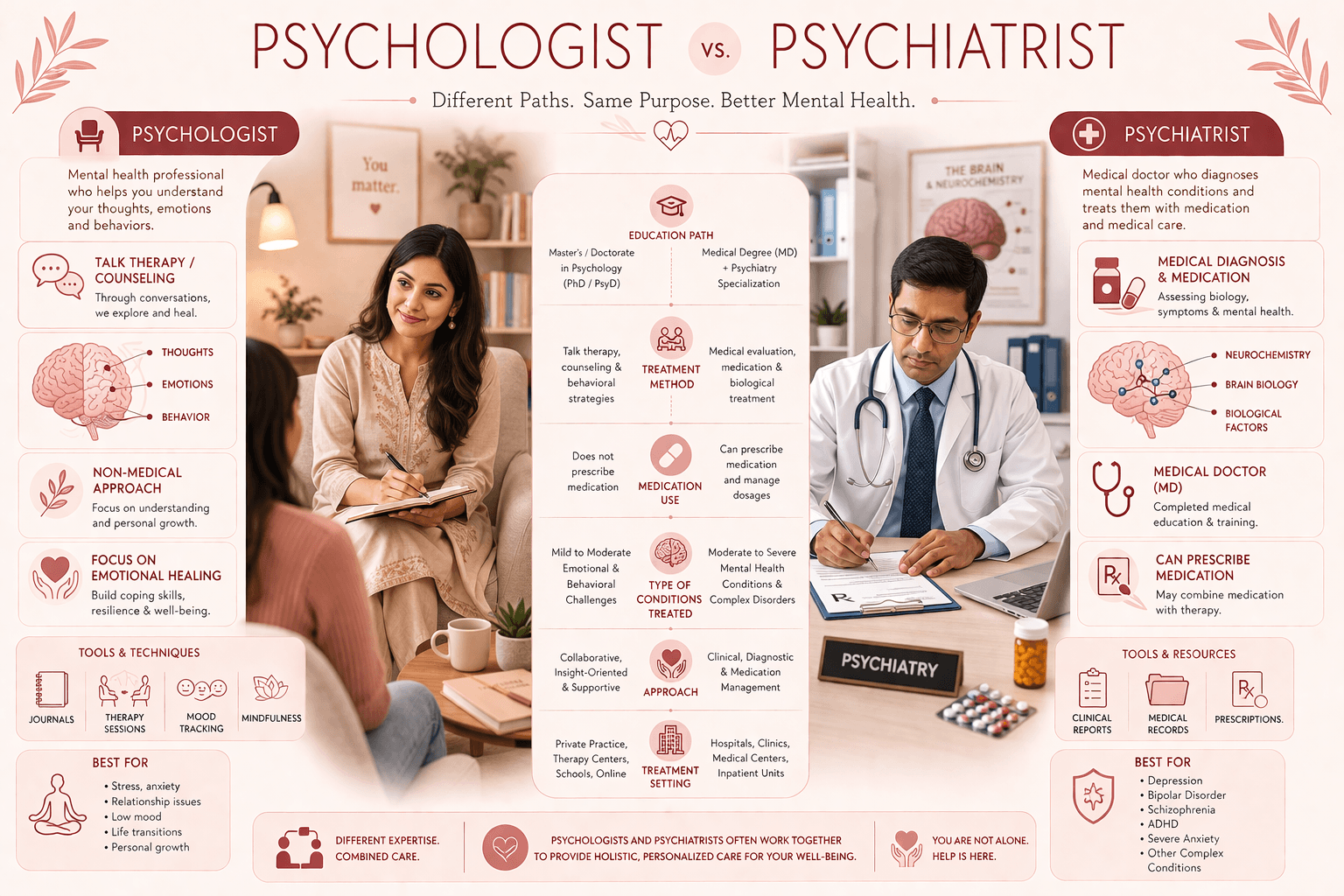
What Does a Psychiatrist Do?
A psychiatrist is a medical doctor. That's the single most important thing to understand about them, because it shapes everything else about how they work.
After completing a standard medical degree, which itself takes four to six years depending on the country, a psychiatrist then completes a specialized residency in psychiatry, usually another four years. Some go further and complete subspecialty fellowships in areas like child and adolescent psychiatry, geriatric psychiatry, addiction psychiatry, or forensic psychiatry. From start to qualified practice, becoming a psychiatrist can take ten to fifteen years of training.
All of that medical training means a psychiatrist doesn't just understand mental illness, they understand the body. They can order and interpret lab tests. They can review brain imaging. They can look at how physical conditions and medications might be contributing to psychological symptoms. They are trained to see the whole picture, which is particularly important when a person's mental health challenges have biological roots.
What Happens in a Psychiatrist's Session?
A first appointment with a psychiatrist is more like a medical consultation than a therapy session. They'll ask you detailed questions about your symptoms, when they started, how severe they are, whether other treatments have been tried, what your family history looks like, and what your overall physical health is like. They might check your blood pressure, order blood tests, or review medications you're already taking.
The goal of this initial appointment is a thorough diagnostic assessment. Psychiatrists are trained to diagnose mental health disorders, which they do using established frameworks, most commonly the DSM (Diagnostic and Statistical Manual of Mental Disorders). Once they have a clear picture, they'll recommend a treatment plan.
That treatment plan will often include medication. Not always, but in many cases, especially where the condition is complex or hasn't responded to therapy alone, medication becomes a central part of the approach. Psychiatrists can prescribe antidepressants, anti-anxiety medications, mood stabilizers, antipsychotics, and many other types of psychiatric medication. They monitor how you respond, adjust doses, and manage any side effects.
How Often Do You See a Psychiatrist?
Less frequently than a psychologist, in most cases. Once a treatment plan is established and medication is stabilized, many people see their psychiatrist every few months, rather than every week. The focus shifts to monitoring how things are going, checking in on medication effectiveness, and making adjustments as needed. Some psychiatrists also provide therapy alongside medication management, though this varies considerably.
What Conditions Does a Psychiatrist Typically Treat?
Psychiatrists are best suited for conditions that are more complex, severe, or where the biological and neurological dimensions are significant. Schizophrenia, bipolar disorder, major depressive disorder, severe OCD, severe anxiety disorders, ADHD (particularly in complex presentations), psychosis, personality disorders, and eating disorders that require intensive medical management are all areas where a psychiatrist's medical training is invaluable.
If you're dealing with a condition that has significantly impaired your ability to function, that hasn't improved with therapy alone, or where there's a strong likelihood that medication will be part of the solution, a psychiatrist is often the right starting point.
Psychologist vs Psychiatrist: The Key Differences That Actually Matter
Now that we've covered each profession on its own, let's put them side by side in a way that actually helps you understand the differences rather than just recite facts.
Training and qualifications. A psychologist holds a doctoral degree in psychology. A psychiatrist holds a medical degree followed by a psychiatric residency. Both require years of supervised practice and licensing examinations. Neither is "more qualified" in a general sense. They're trained for different things.
Prescribing medication. This is the clearest practical difference. Psychiatrists can prescribe medication. Psychologists, in most countries, cannot. If you need medication as part of your treatment, you'll need a psychiatrist or a primary care doctor to prescribe it.
Primary treatment approach. Psychologists primarily use various forms of talk therapy and behavioral interventions. Psychiatrists primarily work through diagnosis, medication management, and often shorter, more medically-focused consultations. That said, many psychiatrists also provide therapy, and psychologists can absolutely assess and diagnose mental health conditions.
Session frequency and duration. Psychologists typically meet with clients weekly, especially at the start of treatment. Psychiatric appointments are often less frequent, sometimes monthly or even quarterly once things are stable, and tend to focus more on monitoring than extended conversation.
Conditions best suited for each. For anxiety, depression at a manageable level, relationship issues, trauma, behavioral patterns, and general emotional well-being, a psychologist is usually the first point of contact. For conditions that are severe, complex, recurring, or clearly requiring medication, a psychiatrist is more appropriate.
Cost. Psychiatrist consultations tend to be more expensive than sessions with a psychologist, largely because of the medical training involved. The gap can be significant, and it's worth understanding before you begin.
How a Psychologist and Psychiatrist Can Work Together
Here's something that doesn't get said enough: for many people, the best outcome comes from working with both.
This is what's called a collaborative or multi-disciplinary approach to mental health care, and it's increasingly considered the gold standard. The idea is simple: a psychiatrist handles the diagnostic assessment and medication management, while a psychologist provides ongoing therapy. The two communicate about your progress, adjusting their respective contributions as needed.
Imagine someone dealing with moderate to severe depression. A psychiatrist might diagnose the condition, identify that an antidepressant could help stabilize mood, and start them on medication. Meanwhile, a psychologist works with them weekly to explore the thought patterns and life factors contributing to the depression, and to build skills for managing it long-term. The medication helps lift the floor, making it possible for the person to actually engage with therapy. The therapy builds the foundation for lasting change. Neither is working against the other; they're working in parallel.
This kind of collaboration is also common for conditions like bipolar disorder, PTSD, eating disorders, and ADHD. It's not about doing twice the work. It's about addressing the condition from all the angles it actually occupies.
If you're already seeing one and feel like you might benefit from the other, it's completely reasonable to bring that up. A good psychologist will tell you honestly if they think you'd benefit from a psychiatric assessment. A good psychiatrist will refer you to a psychologist for therapy if that's what would help. The best practitioners think in terms of your overall care, not their individual scope.
Common Myths That Are Worth Clearing Up
Mental health care is still surrounded by misconceptions, many of which stop people from getting the help they need. Let's address some of the most common ones.
"Seeing a psychiatrist means you're seriously mentally ill." This is one of the most damaging myths. Psychiatrists treat the full range of mental health challenges, from mild anxiety and depression to more complex conditions. You don't have to be in crisis to see one. If you think medication might help, or if your GP refers you, seeing a psychiatrist is a completely reasonable step.
"Psychologists just listen and don't actually do anything." Therapy is active work. A psychologist isn't just nodding and taking notes. They're using evidence-based techniques, giving you exercises and frameworks, and helping you build real skills. The process requires genuine effort on your part, but it's not passive. The "they just listen" stereotype couldn't be further from the truth.
"You need a referral to see a psychologist or psychiatrist." This varies by country and whether you're going through public or private healthcare, but in many places, you can self-refer to a psychologist directly. For psychiatrists, a referral from a GP is more commonly required, particularly through public health systems. But the barriers are generally lower than people assume.
"If therapy isn't working quickly, it's not working." Mental health treatment takes time. Most therapeutic approaches are designed to create lasting change, not quick fixes. Six to twelve weeks is often mentioned as a minimum before you can genuinely assess whether something is helping. Real progress, the kind that sticks, usually takes longer.
"Medication is a crutch or a sign of weakness." Medication for mental health conditions is no different from medication for diabetes or hypertension. When brain chemistry is contributing to suffering, treating it with medication is simply sensible medicine. There's no moral dimension to it.
"All therapists are the same." As we've seen, the people who provide mental health support have vastly different training and scope. A counselor, a psychologist, and a psychiatrist are all "mental health professionals," but they're doing meaningfully different things. Knowing the difference helps you find the right fit.
When Should You See a Psychologist, and When Should You See a Psychiatrist?
This is the question most people are actually trying to answer when they start researching this topic. Here's a practical way to think about it.
Start with a psychologist if your challenges are primarily emotional or behavioral. If you're dealing with anxiety, low mood, stress, difficult life transitions, relationship problems, trauma, or patterns of thinking that are getting in your way, a psychologist is often the right first step. Therapy addresses these things directly and can be enormously effective on its own.
Consider seeing a psychiatrist if your symptoms are severe enough to significantly interfere with your ability to function. If you're struggling to work, maintain relationships, or get through basic daily tasks because of mental health symptoms, that severity warrants medical evaluation. Similarly, if therapy alone hasn't been enough, or if you're experiencing symptoms like hallucinations, extreme mood episodes, or psychosis, a psychiatric assessment is important.
See a psychiatrist if medication is already part of the picture. If your GP has prescribed something for depression or anxiety, and you need ongoing monitoring or a specialist's input, a psychiatrist is who you need.
When you're unsure, starting with your GP or a primary care physician is often the most practical option. They can assess what's going on and point you in the right direction, whether that's a psychologist, psychiatrist, or another kind of mental health professional altogether.
Warning signs that you shouldn't wait to address include severe changes in mood that come on quickly and feel extreme, losing interest in activities that used to matter to you, significant changes in sleep or appetite, difficulty concentrating or thinking clearly, feeling disconnected from reality, withdrawing from people around you, or thoughts of harming yourself. Any of these are reasons to seek help promptly, and if there's any immediate safety concern, urgent medical care is the right move.
What to Expect on Your First Visit
Walking into any mental health appointment for the first time can feel daunting. Knowing what to expect helps.
With a psychologist, your first session is often called an intake or assessment session. They'll ask why you've come in, what's been going on in your life, and what you're hoping to get out of the process. They might ask about your family history, significant life events, how long you've been experiencing the current challenges, and what you've tried before. At the end of the session, they'll typically explain what they observed, what they think might help, and how they'd suggest approaching the work together. You're also entirely welcome to ask them questions about their approach, their experience with your kind of issues, and what the therapeutic process will look like. It's a two-way conversation.
With a psychiatrist, the first appointment is more of a comprehensive clinical assessment. Expect to spend time going through your medical history, mental health history, and current symptoms in detail. They may ask you to fill out questionnaires before or during the visit. Some psychiatrists also do basic physical checks, like blood pressure, or arrange for blood tests, particularly if physical health issues might be contributing to mental health symptoms. After the assessment, they'll discuss their findings and recommendations, which may include medication, therapy, or both. You should leave with a clear understanding of what they believe is going on and what the suggested next steps are.
In both cases, be honest. The more clearly you can describe what you're experiencing, the better your provider can help. Don't minimize symptoms or try to seem like you're doing better than you are. The whole point is to get an accurate picture so the right help can be given.
Beyond Psychologists and Psychiatrists: Other Mental Health Professionals
The mental health field includes more than just these two roles, and it's worth knowing who else is out there.
Counselors and therapists at the master's level, including licensed clinical social workers, licensed marriage and family therapists, and licensed professional counselors, provide talk therapy and are qualified to help with a wide range of mental health challenges. They don't have doctoral-level training, but many are highly experienced and effective. For issues like stress, relationship difficulties, grief, and mild to moderate anxiety or depression, they can be an excellent and more affordable option.
CBT therapists specialize specifically in Cognitive Behavioral Therapy. If your needs are clearly suited to this approach, seeing a dedicated CBT therapist can be highly focused and efficient.
Psychotherapists typically offer longer-term, more in-depth therapeutic work, often exploring deeper psychological material including early life experiences, unconscious patterns, and recurring life themes. For persistent or long-standing challenges, this kind of depth can be exactly what's needed.
Psychiatric nurses and nurse practitioners in some regions have prescribing authority and can fill a role that sits between a therapist and a psychiatrist, providing both medication management and therapeutic support.
What matters most is finding someone qualified, licensed, and a good fit for your specific needs. Don't hesitate to ask about credentials and approach before committing to sessions.
Mental Health Support in Himachal Pradesh: What You Should Know
Mental health care in India has come a long way, though the need still outpaces the availability of services in many regions. For people living in Himachal Pradesh, including those in Palampur, Dharamshala, Kangra, and surrounding areas, access to qualified psychological support has historically been limited compared to urban centers.
That's gradually changing. There are now trained counseling psychologists offering services in Himachal Pradesh, including individual counselling, couple counselling, child and teenage counselling, family counselling, stress and anxiety counseling, anger management counselling, de-addiction counselling, and career counselling. Many of these professionals also offer online and virtual sessions, which removes the barrier of distance entirely. Whether you're in Dharamshala, in a smaller town in Kangra district, or even a village in the Palampur region, reaching a qualified psychologist through video call is entirely possible.
If you're searching for the best psychologist in Himachal Pradesh, or specifically looking for mental health support in Palampur, Dharamshala, or Kangra, it's worth seeking out practitioners who are both qualified and familiar with the cultural context of the region. Mental health isn't something that exists in a vacuum, and working with someone who understands the particular pressures, stigma, and family dynamics common in this part of India can make the therapeutic relationship that much more meaningful.
Vaishalya Healing, led by counseling psychologist Leena Mehta in Palampur, is one such practice. With over a decade of experience working in rehabilitation and private practice across Himachal Pradesh, Leena Mehta offers evidence-based therapy, de-addiction counselling, individual and couple sessions, ADHD testing, personality assessments, and more, both in person and online. The approach at Vaishalya Healing is deeply personalized, which matters because good therapy is never a formula. If you've been looking for a trusted psychologist near you in Himachal Pradesh, this kind of local, qualified, and compassionate support is worth knowing about.
If your situation is more complex and you believe psychiatric evaluation or medication management may be needed, your psychologist or GP can help facilitate a referral to a psychiatrist. The collaborative model works just as well in this region as anywhere else.
Talking to Someone About Getting Help
One of the hardest parts of seeking mental health support isn't finding the right professional. It's often just telling someone, whether that's a family member, a friend, or even your own GP, that you're not okay and you want help.
Stigma around mental health is still real in many communities, especially in more traditional or rural settings where the idea of "going to a psychologist" or "seeing a psychiatrist" carries weight and judgment. It's worth saying plainly: there is no shame in this. Seeking mental health care is not a sign of weakness, instability, or failure. It's a sign of self-awareness and the courage to do something about it.
A few things that might help if you're trying to start the conversation. Be direct rather than vague. Instead of saying "I've been feeling a bit off," try saying "I've been struggling with anxiety for a while and I think I need to talk to someone." The clearer you are, the easier it is for the person you're talking to, whether that's a doctor or a family member, to actually help.
If you're supporting someone else who may need help, approach it with curiosity rather than alarm. Ask how they're doing and actually listen. Don't rush to offer solutions. Gently mention that talking to someone professional is an option, not something to be embarrassed about.
And if you're a parent wondering whether your child needs support, trust your instincts. Child and teenage counselling exists because young people experience genuine mental health challenges too. Early support, when something feels off, is always better than waiting until things become a crisis.
A Final Word: You Don't Have to Have It All Figured Out Before You Start
A lot of people delay getting mental health support because they're not sure which professional to see, or whether what they're experiencing is "serious enough," or whether they'll be judged. All of those are understandable hesitations, but they're also reasons that keep people suffering longer than necessary.
You don't need to walk in with a diagnosis. You don't need to know whether you need a psychologist, a psychiatrist, or something else entirely. What you need is to take one step. Talk to your GP, or reach out to a local counseling psychologist, and let the process unfold from there. The people in this field are used to working with uncertainty, and a good professional will help you figure out what kind of support is right for you.
Psychologists and psychiatrists are both extraordinary in what they do. One works with the mind through conversation and behavioral change. The other works through medicine and neuroscience. Both care about the same fundamental thing: helping people live better, more whole, less burdened lives.
Whichever door you walk through first, walking through one is what matters most.
If you are based in Himachal Pradesh and are looking for counselling support in Palampur, Dharamshala, Kangra, or nearby areas, Vaishalya Healing offers confidential individual counselling, couple counselling, stress and anxiety counseling, de-addiction support, child and teenage counselling, and family counselling, both in person and via online sessions. Visit vaishalyahealing.com or call +91 70181 48449 to book an appointment.
Further Reading from Vaishalya Healing
Counseling
Help Center
Contact Us
Office Timings: 10:00 AM to 6:30 PM
Open all days of the week
Address: Mohal Gugga Saloh
Tehsil Palampur, Distt. Kangra
Himachal Pradesh - 176102
Email: help@vaishalyahealing.com
Phone/WhatsApp: +91 7018148449