
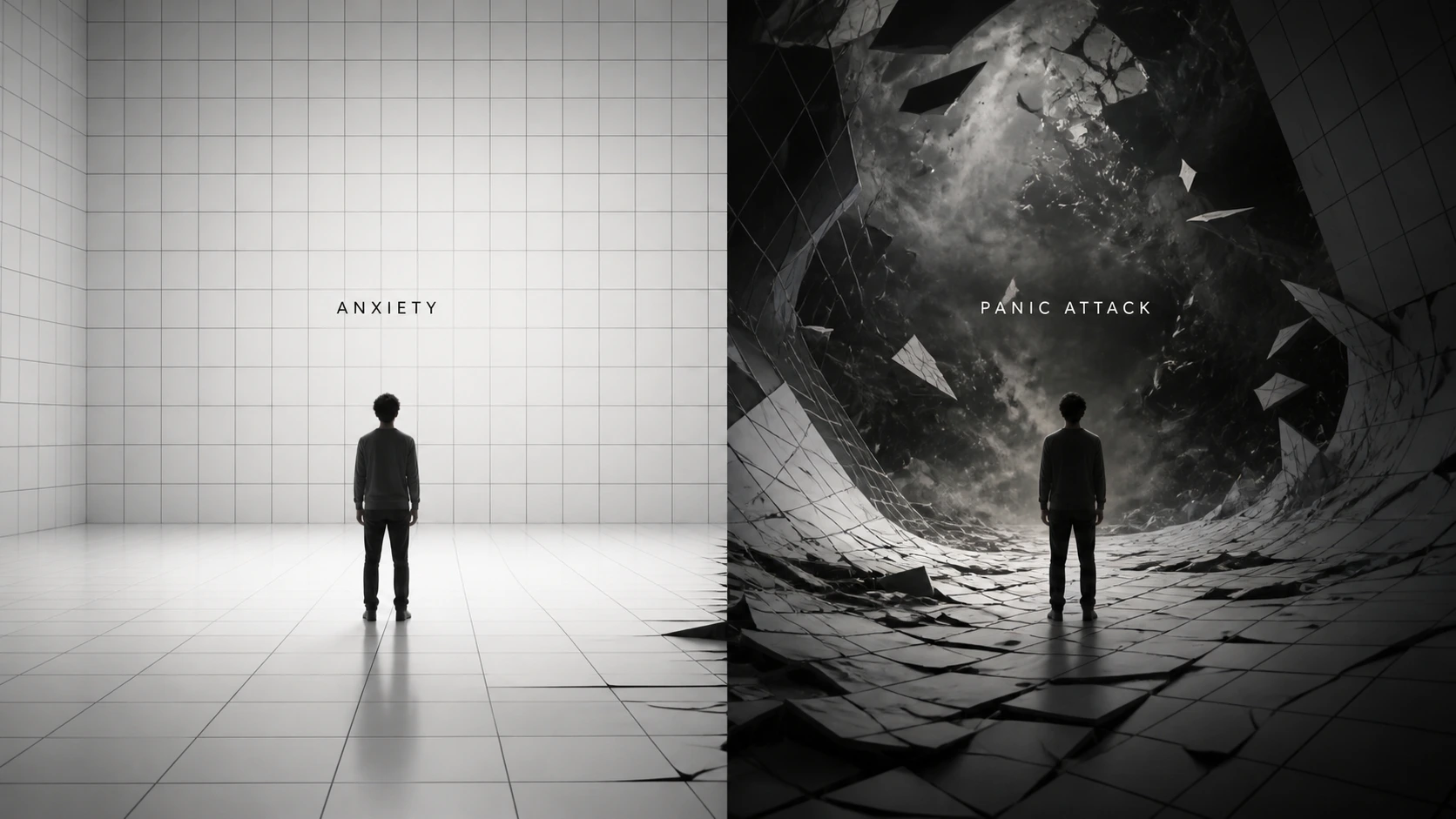
Anxiety Attack vs. Panic Attack: What Is the Difference and What Should You Do?
We live in an era where the term "anxiety" has become very common. People often use the phrases "anxiety attack" and "panic attack" interchangeably to describe the overwhelming stress of modern life. However, from a clinical, psychological, and neurological perspective, these two experiences are different. If you are struggling to understand what is happening in your mind and body, or trying to help someone else, it is important to understand how our natural survival mechanisms can sometimes work against us. This post explores the differences between an anxiety attack and a panic attack, and offers practical ways to handle them.
The Slow Burn: What Is an Anxiety "Attack"?
To understand an anxiety attack, we must first look at how anxiety develops. Fear is a natural response that helps us survive by reacting to immediate danger. If a car suddenly speeds toward you, your body reacts instantly to protect you.
Anxiety, however, is different. It happens when the mind tries to predict the future without having enough certainty. In simple terms, fear plus uncertainty often creates anxiety.
Anxiety is usually experienced as a slow build. It can feel like a constant background tension without a clear reason. It often attaches itself to situations or thoughts, as if the mind is searching for something to worry about.
In the Indian context, this frequently shows up around exam pressure, job stress, family expectations, or social comparison.
Anxiety is fundamentally a response to future uncertainty or perceived danger. Because the brain dislikes uncertainty, it pushes us into thinking and worrying in an attempt to feel in control. This creates a repeating pattern.
The worry begins with a trigger such as stress or discomfort. The mind responds by trying to solve it through overthinking. This may give a temporary sense of control, but usually increases anxiety over time, creating a loop.
Symptoms of this slow-building anxiety include restlessness, fatigue, difficulty concentrating, irritability, and muscle tension.
The Tea Kettle Boiling Over: What Is a Panic Attack?
If anxiety builds slowly, a panic attack is sudden and intense.
Panic is a powerful surge of fear that takes over the body. While anxiety is more connected to thoughts, panic attacks are strongly physical. They can happen without warning, even during sleep.
Many people describe waking up suddenly with a racing heart, sweating, and difficulty breathing, even without any clear trigger. The physical symptoms can feel extreme, including shortness of breath, trembling, dizziness, and a strong sense that something terrible is about to happen.
The body's fight, flight, or freeze response becomes highly active. For many people, it genuinely feels like a life-threatening situation such as a heart attack.
One of the biggest challenges is what happens after the attack ends. A single panic attack can lead to a lasting fear of having another one.
This creates a new pattern where certain situations begin to feel unsafe. For example, if someone experiences a panic attack while driving, they may start avoiding driving altogether. This avoidance brings temporary relief, but reinforces the fear over time and can gradually limit daily life.
Summarizing the Differences
Anxiety tends to build gradually. It develops through ongoing worry, stress, and overthinking, sometimes over long periods. Panic attacks, on the other hand, occur suddenly and reach peak intensity within minutes.
Anxiety is more connected to thinking patterns, involving worry about future events. Panic is more physical, with intense bodily sensations like a racing heart, breathlessness, and a feeling of losing control.
Anxiety often lingers in the background, while panic attacks are short but intense, followed by exhaustion and sometimes fear of recurrence.
What You Should Do: How to Break the Cycle
Whether it is anxiety or panic, trying to force the mind to calm down usually does not work. When the brain's survival system is active, logical thinking becomes less effective. This is why simply telling yourself to relax often fails.
Instead of fighting the experience, it helps to work with how the brain naturally functions.
The first step is awareness. Notice what triggers your anxiety, how you respond, and what the result is. This helps break automatic patterns.
It is also important to avoid getting stuck in overanalyzing why you feel this way. Focusing too much on the cause can become another form of overthinking. What matters more is recognizing what is happening in the present moment.
Another helpful step is to question whether worrying is actually useful. When you observe it closely, worrying often increases discomfort rather than solving the problem. Seeing this clearly can slowly reduce the habit.
Bringing curiosity into the experience can also help. Anxiety often feels tight and uncomfortable in the body, while curiosity feels more open. Instead of resisting the feeling, try noticing it. Observe where it is in your body and how it feels, whether it is tight, heavy, or moving. Simply labeling these sensations can reduce their intensity.
Finally, focusing on the present moment can make a big difference. Thinking too far into the future increases uncertainty and anxiety. Instead, bring your attention to small periods of time. Even staying grounded for a few minutes at a time can help create stability.
The Light at the End of the Tunnel
Anxiety and panic can feel overwhelming and exhausting. But they are not permanent states, and they do not define you. They are natural responses that have become overly sensitive.
With awareness and the right approach, these patterns can change. The next time anxiety or panic arises, you do not have to fight it or escape it. You can pause, observe it, and allow it to pass.

Struggling with loneliness, relationships, or grief?
A real conversation can change everything.
At Vaishalya Healing, we offer compassionate, human-centred therapy that no algorithm can replicate. Whether you are navigating the complexities of modern relationships, healing from loss, or simply feeling disconnected and we are here for you.
Book a Free Consultation Explore Our ServicesVisit the Clinic
Vaishalya Healing
Consultation available in-person & online
Read More
Explore more articles on mental wellness, modern relationships, and healing at: